Rustochem 680 Derusting Solution
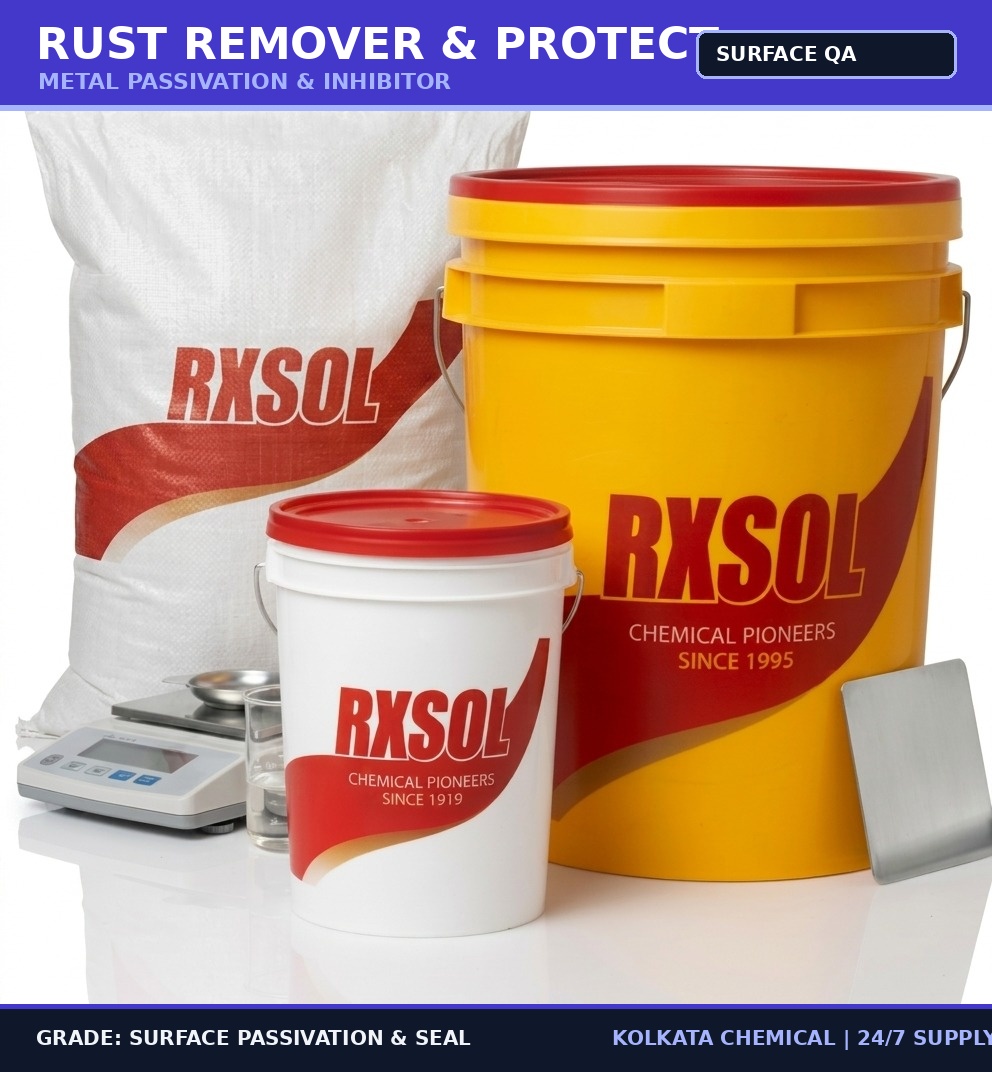
RXSOL RUSTOCHEM 680 is DERUSTING SOLUTION and an aqueous mixture, soluble in varying proportions with water. It is a very effective degreaser,scales and rust remover from the metal . It is highly concentrate and easly desolves oil and grease. It has

RXSOL RUSTOCHEM 680 is DERUSTING SOLUTION and an aqueous  mixture, soluble in varying proportions with water. It is a very effective degreaser,scales and rust remover from the metal . It is highly concentrate and easly desolves oil and grease. It has long chain molecular surfactant which provide complete cleaning of surface and prepair base for phosphate coating, zinc coating and painting.RXSOL RUSTOCHEM 680 is used at low temperatures and low concentrations and does not give rise to scale or sludge nor does it generate fumes in working environment. A uniform matt finish is produced over a wide concentration range with a low level of metal removal.

Application

RXSOL RUSTOCHEM 680  is most suitable for pre-treatments before Phosphate coating, zinc coating and painting as it performs three functions simultaneously mainly that of degreasing, etching and desmutting. Phophate coatings thus produced after pretreatment with RXSOL RUSTOCHEM 680  are uniform and adherent. RXSOL RUSTOCHEM 680 is most suitable by dipping process. It is to be used in plastic tank or container.

Dose

This is highly concentrated product and exact parameters should be set after trials. Normal dose is 25 -30% bath concentration on room temperature.

Control & maintenance :

  • Fresh addition of RXSOL RUSTOCHEM 680   should be made daily to maintain the strength of solution by titration procedure.
  • The fresh bath should be prepared only when there is an excess build-up of soils from heavily oiled surfaces, or when normal additions does not restore original rate
  • Oil floating on top should be skimmed off daily
  • The solution should be desludged / filtered once every 3-4 weeks
  • Stir/agitate the solution every day before starting to process
Note

Precautions :

  • Avoid contact with skin, eyes & clothing
  • Protective clothing such as pvc/rubber gloves, eye goggles and aprons should be worn while handling or working with RXSOL RUSTOCHEM 680  
  • For splashes/splatters on eyes or skin wash with fresh water continuously for 1 minute then apply calcium gluconate gel and massage into affected area. consult physician if necessary
MSDS

Product Name Rustochem 680 Derusting Solution 
Part Number RXSOL-68-6810-040

Company Details:
RX MARINE INTERNATIONAL
105, A wing , BSEL , TECH PARK.
VASHI ,NEW BOMBAY 400703 INDIA

Phone +91 22 27815540 / 27815541
Fax +91 22 2781 1318 :::AOH :0091 9821214367
Email mail@rxmarine.com
Website www.rxmarine.com

Name     of        Substance                          Cas Number EC Number Wight %
Phosphoric acid 7664 -38 -2    57 - 62%
Surfactant Proprietory    10 - 20%
Corrosion Inhibitor Proprietory    15 - 25%


Signal Word                        Warning
Hazard Statements May be corrosive to metals.
Harmful if swallowed.
Causes severe skin burns and eye damage.
Causes severe damage to the respiratory tract.
Precautionary statements - prevention Keep only in original container. Do not breathe dust/fume/gas/mist/vapors/spray. Wash thoroughly after handling. Wear protective gloves/protective clothing/eye protection/face protection. Do not eat, drink or smoke when using this product.
Precautionary statements - response Absorb spillage to prevent material damage. IF SWALLOWED: Rinse mouth. Do NOT induce vomiting. Immediately call a POISON CENTER or doctor/physician. IF ON SKIN (or hair): Take off immediately all contaminated clothing. Rinse skin with water/shower. Wash contaminated clothing before reuse. IF INHALED: Remove person to fresh air and keep at rest in a position comfortable for breathing. Immediately call a POISON CENTER or doctor. IF IN EYES: Rinse cautiously with water for several minutes. Remove contact lenses, if present and easy to do. Continue rinsing. Immediately call a POISON CENTER or doctor/physician.


Eye Contact Check for and remove any contact lenses. In case of contact, immediately flush eyes with plenty of water for at least 15 minutes. Cold water may be used. Get medical attention immediately.
Skin Contact In case of contact, immediately flush skin with plenty of water. Cover the irritated skin with an emollient. Remove contaminated clothing and shoes. Cold water may be used.Wash clothing before reuse. Thoroughly clean shoes before reuse. Get medical attention.
Inhalation: Move to fresh air. If breathing is difficult, give oxygen. Get medical attention immediately if symptoms occur.
Ingestion: Do not induce vomiting. Obtain medical attention.If vomiting occurs, lean patient forward or place on left side (head-down position, if possible) to maintain open airway and prevent aspiration.
Notes to Physician Treat symptomatically

Flammability                                                  Non-flammable.
Flash Point Not applicable.
Suitable extinguishing media No information available
Hazardous combustion
products
Product itself does not burn, but may decompose upon heating to product carbon monoxide, carbon dioxide, oxides of potassium and nitrogen oxide.
Protective Equipment A positive-pressure, self-contained breathing apparatus (SCBA) and full-body protective equipment are required for fire emergencies.
Fire Fighting Measures Move container from fire area if it can be done without risk. Keep storage containers cool with water spray. Heated containers may rupture. "Empty" containers may retain residue and can be dangerous. Product is not sensitive to mechanical impact or static discharge. 


Small Spillage Use appropriate tools to put the spilled solid in a convenient waste disposal container. Finish cleaning by spreading water on the contaminated surface and dispose of according to local and regional authority requirements
Personal Protection Advice for non-emergency personnel: Avoid inhalation of dusts. Evacuate the danger area, observe emergency procedures, consult an expert. Advice for emergency responders: Protective equipment see section 8.
Enviromental Precaution Do not let product enter drains.
Methods and materials for
containment and cleaning
Cover drains. Collect, bind, and pump off spills. Observe possible material restrictions (see sections 7 and 10). Take up dry. Dispose of properly. Clean up affected area. Avoid generation of dusts


Handling Keep away from sparks or flame. Do not breathe dust or vapors. Contaminated work clothing should not be allowed out of the workplace. Wear protective gloves/protective clothing/eye protection/face protection. Wash thoroughly after handling. Acid reacts with water and can splatter acid onto personnel. When diluting, cautiously mix product and water together while stirring.
Storage Store in corrosive resistant container with a resistant inner liner. Keep container tightly closed when not in use and during transport. Store containers in a cool, dry place. Do not pressurize, cut, weld, braze, solder, drill, or grind containers. Keep containers away from heat, flame, sparks, static electricity, or other sources of ignition. Empty product containers may retain product residue and can be dangerous.
Advice on general occupational hygiene Advice on safe handling Observe label precautions. Change contaminated clothing. Wash hands after working with substance.


Engineering Control Provide general ventilation needed to maintain concentration of vapor or mist below applicable exposure limits. Where adequate general ventilation is unavailable, use process enclosures, local exhaust ventilation, or other engineering controls to control airborne levels below applicable exposure limits.
Personal Protection Eye/face Protection :  Wear appropriate protective eyeglasses or chemical safety goggles as described by OSHA's eye and face protection regulations in 29 CFR 1910.133 or European Standard EN166.
Skin and body protection : Wear appropriate protective gloves and clothing to prevent skin exposure. Respiratory Protection :  Follow the OSHA respirator regulations found in 29 CFR 1910.134 or European Standard EN 149. Use a NIOSH/MSHA or European Standard EN 149 approved respirator  exposure limits are exceeded or if irritation or other symptoms are experienced.
Other Protection Measure Handle in accordance with good industrial hygiene and safety practice.
Exposure Limit Phosphoric Acid TWA: 1 STEL: 3 (mg/m3) from ACGIH (TLV) [United States] TWA: 1 STEL: 3 (mg/m3) from OSHA (PEL) [United States] TWA: 1 STEL: 3 (mg/m3) from NIOSH TWA: 1 STEL: 3 (mg/m3) [Mexico]Consult local authorities for acceptable exposure limits

       gloves                suit                

        Gloves                       Suit                       

Form         Liquid
Colour Clear
Odour Mild
Odor Threshold No Information Available
pH 1  
Freezing Point -0 °C
Boiling Point 101°C
Flash Point Not Applicable
Evaporation Rate Not Applicable
Flammability (solid, gas) No Data Available
Explosive limits No Data Available
Vapour pressure 11 mmHg @20°C
Vapour Density Not Available
Relative density Information 1.38 - 1.43  at 25 °C
Partition coefficient No data available
Explosive properties None
Solubility Soluble in water
Ignition temperature Not Available

Reactivity                        Corrosive to metals. Contact with most metals produces highly flammable hydrogen gas. May react on contact with water. Reacts violently with alkali.
Stability Product is stable.
Possibility of hazardous reactions Polymerization is not known to occur under normal temperature and pressures.
Conditions to avoid Avoid sparks or flame, direct sunlight. Corrosive to metals.
Incompatible materials Alkali, oxidizers, bases, reducing agents, halogens, metals.
Hazardous Polymerization Hazardous polymerization does not occur.

Rout Of Entry Absorbed through skin. Eye contact. Inhalation. Ingestion.
Toxicity to Animal Acute oral toxicity (LD50): 1530 mg/kg [Rat]. Acute dermal toxicity (LD50): 2740 mg/kg [Rabbit].
Toxic Effects on Human Extremely hazardous in case of inhalation (lung corrosive). Very hazardous in case of skin contact (irritant), of ingestion, . Hazardous in case of skin contact (corrosive, permeator), of eye contact (corrosive).
Special Remarks on other Toxic Effects on Humans: Acute Potential Health Effects: Skin: Corrosive and causes severe skin irritation and can cause severe skin burns. May affect behaviour (somnolence or excitement) if absorbed through the skin. Eyes: Corrosive. Liquid or vapour causes severe eye irritation and can cause severe eye burns leading to permanent corneal damage or chemical conjunctivitis. Ingestion: May be harmful if swallowed. Causes irritation and burns of the gastrointestinal (digestive) tract. Causes severe pain, nausea, vomiting, diarrhea hematemesis, gastrointestinal haemorrhaging, and shock.

Eco Toxicity No ecotoxicity data are available for this product's components. Low pH (acidity) of product may be harmful to aquatic life.
COD and BOD 5 Not Available
Products of Biodegradation: No Information available
Mobility in soil No Information available
Results of PBT and vPvB assessment Not applicable for inorganic substances
Other adverse effects Discharge into the environment must be avoided.


Waste treatment Method Waste material must be disposed of in accordance with the national and local regulations. Leave chemicals in original containers. No mixing with other waste. Handle uncleaned containers like the product itself

DOT 

UN        Number                                          UN 3264
Proper shipping name CORROSIVE LIQUID, ACIDIC, INORGANIC, N.O.S. (Contains: Phosphoric acid  Solution)
Hazard Class 8
Packing group II

TDG 

UN        Number                                          UN 3264
Proper shipping name CORROSIVE LIQUID, ACIDIC, INORGANIC, N.O.S. (Contains: Phosphoric acid  Solution)
Hazard Class 8
Packing group II

IATA

UN        Number                                          UN 3264
Proper shipping name CORROSIVE LIQUID, ACIDIC, INORGANIC, N.O.S. (Contains: Phosphoric acid Solution )
Hazard Class 8
Packing group II

IMDG/IMO

UN        Number                                          UN 3264
Proper shipping name CORROSIVE LIQUID, ACIDIC, INORGANIC, N.O.S. (Contains: Phosphoric acid Solution )
Hazard Class 8
Packing group II


State and federal regulation Connecticut hazardous material survey.: Phosphoric Acid Solution substances disclosure to employee act: Phosphoric Acid Solution chemical safety act: Phosphoric acid: Phosphoric acid Rhode Island RTK hazardous substances: Phosphoric acid Pennsylvania RTK: Phosphoric acid Minnesota: Phosphoric acid Massachusetts.RTK: Phosphoric acid Massachusetts spill list: Phosphoric acid New Jersey: Phosphoric acid New Jersey spill list: Phosphoric acid Louisiana spill reporting: Phosphoric acid California Director's list of hazardous substances: Phosphoric acid TSCA 8(b). inventory: Phosphoric Acid; Water SARA 313 toxic chemical notification and release reporting: Phosphoric acid CERCLA:
Other Regulation OSHA: Hazardous by definition of Hazard Communication Standard (29 CFR 1910.1200).
WHMIS (Canada) CLASS D-1A: Material causing immediate and serious toxic effects (VERY TOXIC). CLASS D-2B: Material causing other toxic effects (TOXIC). CLASS E: Corrosive liquid.
DSCL (EEC) R34- Causes burns. S26- In case of contact with eyes, rinse immediately with plenty of water and seek medical advice. S45- In case of accident or if you feel unwell, seek medical advice immediately (show the label where possible).


Personal Protection

HMIS                               
Health Hazard : 3
Fire Hazard : 0
Reactivity : 0
 H


Fire Protection:                   
Health Hazard : 3
Fire Hazard : 0
Reactivity : 0
Specific Hazard : H

Other Information


The information above is believed to be accurate and represents the  best information   currently    available  to us.  However, we make no warranty of merchantability or any other warranty, express or implied, with respect to such information, and  we assume  noliability resulting from its use. Users should make  their  own  investigations  to determine the suitability of the information for their particular purposes. In no event shall be liable for any claims, losses, or damages of any third party or for lost profits or any special, indirect, incidental, consequential or exemplary damages, howsoever arising, even if RX Marine International  has been advised of the possibility of such damages.

DISCLAIMER OF LIABILITY :The information in this SDS was obtained from sources which we believe are reliable. However, the information is provided without any warranty, express or implied, regarding its correctness. The conditions or methods of handling, storage, use or disposal of the product are beyond our control and may be beyond our knowledge. For this and other reasons, we do not assume responsibility and expressly disclaim liability for loss, damage or expense arising out of or in any way connected with the handling, storage, use or disposal of the product. This MSDS was prepared and is to be used only for this product. If the product is used as a component in another product, this MSDS information may not be applicable.

Need a quote for this product?

Tell us the grade, packing and quantity you need — we ship across India and to major ports.

Request a quote office@kolkatachemical.com