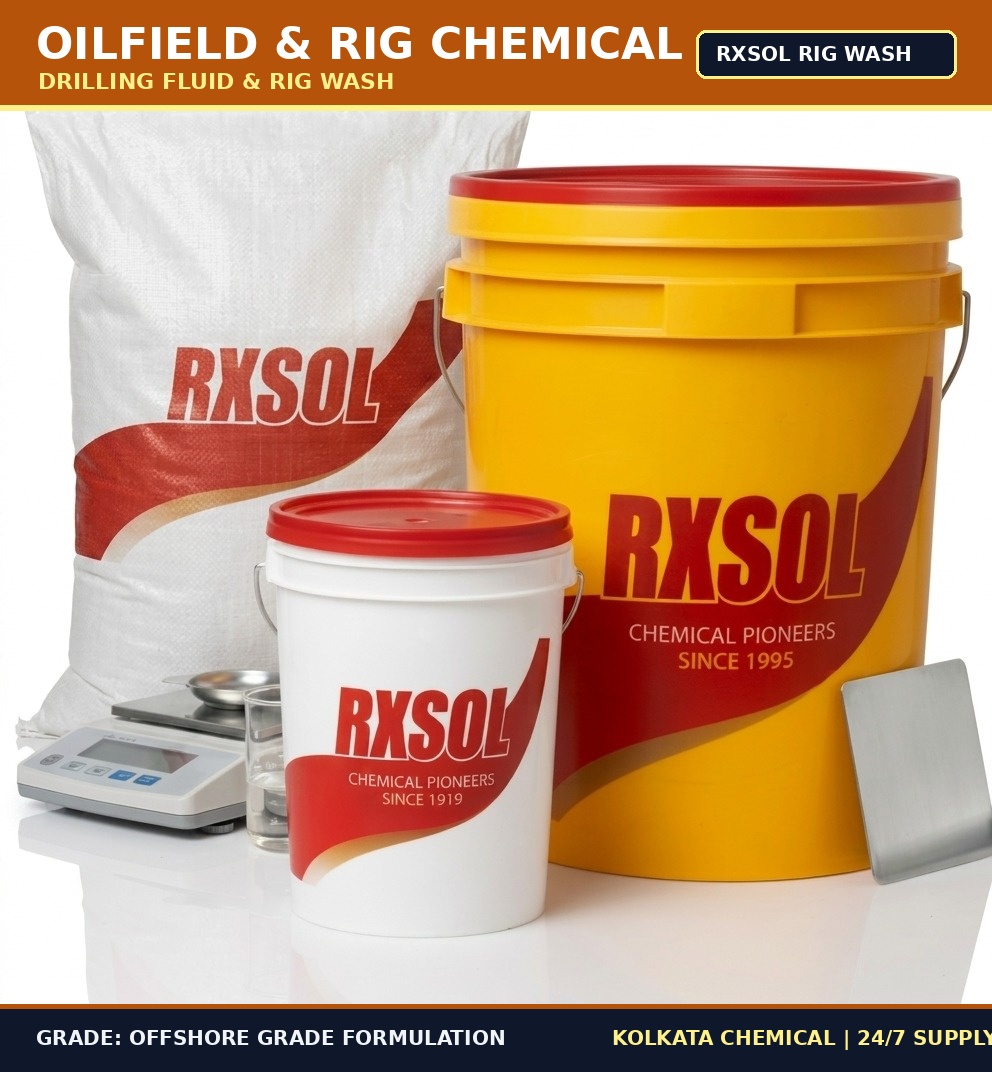
Demulsifier Premium

Can be use as a Separation of emulsified water from crude adsorbent, Sharp interface between crude oil and water.
Category

Oilfield Chemicals Demulsifiers - Demulsifier to successfully separate oil from water. Also suitable for lightest sweet crudes to the heaviest sour crudes.

RXSOL Export quality Demulsifiers is very effective emulsion breakers to separate water in crude oil emulsion. Its excellent performance formulations enable the quick separation of produced water from oil. Acts as a dehydration chemicals.

Chemically RXSOL Demulsifiers  reduce the interfacial tension between hydrocarbon and water, which helps to separate water content quickly.

RXSOL Demulsifier  is a totally organic liquid formulation of surfactants and  soluble in toluene, Xylene, Aromatic solvent, Crude oil for the demulsification of water in oil and oil in water, capable of performance at room temperature, but with improved speed and percentage of oil removed when applied at temperatures near 60 deg. C (140 deg. F). RXSOL crude oil demulsifier destabilizes the oil-water interface that surrounds each water particle in the emulsion, replaces the emulsifier molecules (if any), and allows the water to coalesce. RXSOL crude oil demulsifier (demulsification of crude oil) is a completely combustible, non-abrasive; non-ash-forming treatment, which will improve the quality of the fuel it, is added to. The effects of crude oil demulsifier in demulsification of water in crude oil emulsions are based on relative rates of water separation were recognized through emulsion breakers.

Application

RXSOL DEMULSIFIER is  Water-In-Oil Demulsifiers, which can be used as stand-alone Demulsifiers to separate Formation Water from Crude Oil Emulsion. There are vast differences and Characteristics of Crude Oils produced in various Fields. Use and application Oil Soluble Demulsifier Testing & Selection is accomplished by standard Bottle Tests in Lab followed by Field Trial Tests. They are commonly used in the processing of crude oil for effectively separating formation water from emulsions in crude oil.

Demulsifier to successfully separate oil from water. Also suitable for lightest sweet crudes to the heaviest sour crudes.

Dose

Dose recommendations have to be made on a case-by-case basis. The dosage of RXSOL DEMULSIFIER prescribed to break a particular emulsion varies from as little as 1 ltr per 20,000 Ltrs (50 ppm) of oil to as much as 1 Ltr per 10,000 ltrs (100 ppm) of oil. A few companies have even found that 20 ppm was more effective than the higher dosages, so we suggest adding the lower levels to your laboratory bench tests to verify the correct dosage for the specific application. Finding the most cost-effective dosage, as well as determining the best conditions of temperature, slow mixing, settling time, etc., is best done in the laboratory, using a sample of the actual oil or waste and a sample of Demulsifier.

Technical specifications

Physical Data:

 Physical appearance Clear free flowing brown colour homogeneous liquid
Active Ingredient More then 40 Percent
Specific Gravity @ 25° C 0.92 ± 0.02
Viscosity @ 25° C < 30 cps [cst]
Pour Point < 0° C
ph range 5.0 – 8.0
Solubility in Hydrocarbons Soluble
Solubility in water Insoluble
Flash point ° C >60° C
Shelf Life Minimum two years
Packing 210 Ltrs.
Storage Condition -15 to 55 Degree C
Note

Features and Benefits :

  • Contains surface-active materials
  • Separates water from oil
  • Free from defilements
  • Excellent stability
  • Precise chemical composition
  • Easy to Handle.

Storage and Handling : 

RXSOL DEMULSIFIER shall be stored in closed containers away from direct sunlight at ambient temperature. During handling, direct contact with human body is to be avoided. Safety goggles and gloves are recommended for safe handling. The spillage can be handled with dry absorbent like sand, sawdust, etc. On ingestion / eye contact with the product, medical attention should be sought immediately.
 

Remarks / Precaution
Can be use as a Separation of emulsified water from crude adsorbent, Sharp interface between crude oil and water        
 
Specifications Demulsifies
Coulour   yellow to brown
PH ( concentrated product  5 to 7
Melting / freeze point < -30 c
Flash point at 38 c > 40 c
Density  ( 0.90 to 0.96)
Pour point = -15 c
Viscosity = 15 to 60 cst of 40  
Packing sizes
Demulsifier is available in 25, 50, 210, 1000 Ltr IBC tank available at Fujairah, Dubai, Sharjah, Mumbai, Kandla, Chennai, Kolkata, Visakhapatnam.
MSDS

Part Number RXSOL-16-2064-210
Product Name Demulsifier  HS CODE : 34021300

 Company Details:

RX MARINE INTERNATIONAL
105, A wing , BSEL , TECH PARK.
VASHI ,NEW BOMBAY 400703 INDIA

STOCK POINT : Mumbai, Kandla, Chennai, Visakhapatnam, Kolkata, Fujairah, Muscat

Phone +91 22 27815542 / 41
Fax +91 22 2781 1318 :::AOH :0091 9821214367
Email mail@rxmarine.com

This product is classified as dangerous in accordance with the Preparations Directive 1999/45/EC.  

Name EC. No. CAS-No. Content Classification

2-ETHYL HEXANOL

203-234-3 104-76-7 5-10%

Xi;R36/38. R52.

Benzene Sulphonic Acid 416-730-1 98-11-3 5-10%  
AgNO3 231-853-9 7761-88-8 1  
FUELS, DIESEL; GASOIL - UNSPECIFIED 269-822-7 68334-30-5 30-60% R40
ISO-BUTANOL 201-148-0 78-83-1 1-5% R10 R41 R67
NAPHTHALENE 202-049-5 91-20-3 1 R22 N;R50/53
1,2,3-Trimethylbenzene 208-394-8 526-73-8 1-5% R36

SOLVENT NAPHTHA (PETROLEUM),
HEAVY AROMA KEROSINE - UNSPECIFIED

265-198-5 64742-94-5 5-10% R65
Proprietory Blend - - 5-10% -

The full Text for all R-Pherases are Displayed in Section 16 
 

Odour

Solvent odour.

Appearance

Liquid, Pale Yellow

Contact with eyes

Risk of serious damage to eyes (R41).

Contact with skin

Causes irritation, Prolonged skin contact will result in defatting of the skin, leading to irritation, and in some cases, dermatitis .

Inhalation

Vapours or aerosols may cause irritation of eyes, nose and respiratory tract, In cases of severe exposure, shortness of breath may  develop.

Ingestion

Harmful: may cause lung damage if swallowed (R65).


INHALATION :

Move the exposed to fresh air at once provide rest, warmth and fresh air. perform artificial respiration if breathing has stoped when breathing is difficult, properly trained personnel may assist affected person by administering oxygen. Get medical attention if any discomfort continues.

INGESTION

DO NOT INDUCE VOMITING! NEVER MAKE AN UNCONSCIOUS PERSON VOMIT OR DRINK FLUIDS! Rins mouth thoroughly. Drink plenty of water. Provide rest, warmth and fresh air Get medical attention if any discomfort continues.

 SKIN CONTACT

Remove affected person from source of contamination. immediately remove contaminated clothing. Wash the the skin immediately with soap and water. Get medical attention if irritation persists after washing

EYE CONTACT

Promptly wash eyes with pleanty of water while lifting the eye lids. Continue to rinse for at least 15 minutes. Get Medical attention if any discotinues.

EXTINGUISHING MEDIA 

Use: Water spray. foam. Dry chemicals carbon dioxide (CO2).

SPECIAL FIRE FIRE FIGHTING PROCEDURES 

Cool Containers exposed to flames with water until well after the fire is out.

SPECIFIC HAZARDS By fire, toxic gases may be formed (COx, NOx)
PROTECTIVE MEASURES IN FIRE Full Protective equipment including suitable respiratory protection

PERSONAL PRECAUTIONS

Wear Suitable Protective clothing to Prevent skin contact. Use respiratory protection in confined areas.

SPILL CLEAN UP METHODS

Wear necessary protective equipment. Avoid contact with skin or inhalation of spillage, dust or vapour. stop leak if possible without risk. Absorb in vermiculite, dry sand or earth and place into containers. Do not contaminate water sources or sewer. Inform Authorities if large amounts are involved. Flush with plenty of water to clean spillage area. Do not let Washing down water contaminate ponds or waterways.

Usage Precautions

Avoid spilling  skin and eye contact. ventilate well avoid  breathing vapours. use approved respirator if air contamination is above accepted level.

STORAGE PRECAUTION

Store in tightly closed original container in a dry, cool  and  well - ventilated place . keep containers tightly closed. Avoid contact with  oxidising  agents.

INGREDIENT COMMENTS

WEL=Workplace Exposure Limits

ENGINEERING MEASURES

 Provide adequata ventilation Observe Workplace Exposure limits and minimise  the risk of inhalation of vapours.
 

RESPIRATORY EQUIPMENT

 If ventilation is insuffcient, suitable respiratory protection  must be provided.

HAND PROTECTION

Nitrile gloves are recommended, but be aware that the liquid  may penetrate the gloves. Frequent change is advisable.

EYE PROTECTION

Use approved safety goggles or face  shield.

OTHER PROTECTION Wear appropriate clothing to prevent any possibility of skin contact.
HYGINENE MEASURES

Wash at the end of each work shift and before eating, smoking and using the toilet. wash promptly if skin become wet or contaminated. promptly remove any clothing that becomme contaminated. use appropriate skin crem to prevent drying of skin.


 APPEARANCE Liquid
COLOUR Clear to Amber
RELATIVE DENSITY  0.9-0.95 @ 25.C
VISCOSITY  ˂15 at 30C
FLASH PONIT (.C)  9°C (>48.2°F)
Pour Point -28
pH 5-8


Chemical Stability:Stable under normal conditions of use and storage.
Incompatibility:Strong oxidizing agents such as Nitrates,
Perchlorates or SulfuricAcid, heat, sparks, open flame. Will attack some forms of plastics, rubber and coatings.
Hazardous Decomposition Products:
May form Carbon monoxide and Carbon dioxide when heated to decomposition.
Hazardous Polymerization:Will not occur.

LD50, Oral , Rat: (636 mg/kg, details of toxic effects not reported other than lethal dose value.
Delayed and immediate effects and also chronic effects from short and long term exposure Short term exposure

 Potential immediate Not available. effects
Potential delayed effects  Not available. Potential chronic health effects
General  No known significant effects or critical hazards
Carcinogenicity No known significant effects or critical hazards.
 Mutagenicity No known significant effects or critical hazards.
Teratogenicity No known significant effects or critical hazards.
Developmental effects No known significant effects or critical hazards.
Fertility effects No known significant effects or critical hazards.
Numerical measures of toxicity Acute toxicity estimates  
Route                                       ATE value
Oral                                         976.6 mg/kg
Dermal  3245.9 mg/kg
Inhalation (gases)  410289.5 ppm
Inhalation (vapors) 26.06 mg/l

Efficient data are available to evaluate the short and long term effects of Aromatic Hydrocarbon to aquatic life plants, birds, or land animals.
Chemical Fate Information: Aromatic Hydrocarbon Solvent is non -persistent in water with a half-life of less than 2 days. This material is not expected to significantly bioaccumulate.When released into the soil or into water, this material is expected to quickly evaporate.

Absorb with suitable inert material (vermiculite, dry sand, earth) and place in a chemical waste container for proper disposal in an approved waste disposal facility for incineration in a chemical incinerator equipped with scrubber and afterburner. Do not flush to sewer.
Ventilate area of spill. Have extinguishing agent available in case of fire. Eliminate all sources of ignition. Use non-sparking tools and equipment. Always dispose of in accordance with local, state and federal regulations

Disposal of this product, solutions and any by-products should at all times comply with the requirements of environmental protection and waste disposal legislation and any regional local authority requirements. Dispose of surplus and non-recyclable products via a licensed waste disposal contractor. Waste should not be disposed of untreated to the sewer unless fully compliant with the requirements of all authorities with jurisdiction. Waste packaging should be recycled. Incineration or landfill should only be considered when recycling is not feasible. This material and its container must be disposed of in a safe way. Care should be taken when handling emptied containers that have not been cleaned or rinsed out. Empty containers or liners may retain some product residues. Vapor from product residues may create a highly flammable or explosive atmosphere inside the container. Do not cut, weld or grind used containers unless they have been cleaned thoroughly internally. Avoid dispersal of spilled material and runoff and contact with soil, waterways, drains and sewers.
 

D.O.T. Shipping Name: Aromatic Hydrocarbon MixtureFlammable Liquid Mixture

ROAD TRANSPORT (ADR)
  ADR class 3
RAIL TRANSPORT (RID)
  RID class no.  3
SEA TRANSPORT (IMDG)
  IMDG class 3
AIR TRANSPORT (IATA/ICAO)
  IATA/ICAO class 3
 

U.S. DOT 49 CFR 172.101:
PROPER SHIPPING NAME: 
Flammable Liquid Mixture ID NUMBER: UN1993
HAZARD CLASS OR DIVISION: 3
PACKING GROUP: II 

TRANSPORTATION OF DANGEROUS GOODS: Transport within user’s premises: always transport in closed containers that are upright and secure. Ensure that persons transporting the product know what to do in the event of an accident or spillage of flammable liquid.

LAND TRANSPORT ADR/RID:
PROPER SHIPPING NAME: 
Flammable Liquid Mixture UN NUMBER: UN1993
ADR/RID CLASS: 3
CLASSIFICATION CODE: C6
PACKING GROUP: II 

AIR TRANSPORT IATA/ICAO:
PROPER SHIPPING NAME: 
Flammable Liquid Mixture IATA/ICAO CLASS: 8
PACKING GROUP: II 

MARITIME TRANSPORT IMDG:
PROPER SHIPPING NAME: 
Flammable Liquid Mixture UN NUMBER: UN1993 
IMDG CLASS: 3 PACKING GROUP: II 


OSHA Status:These items meet the OSHA Hazard Communication Standard (29 CFR 1910.1200) definition of a hazardous material.
TSCA Status:All components of this solution are listed on the TSCA Inventory or are mixtures (hydrates) of items listed on the TSCA Inventory.
Sara Title III:

Section 302 Extremely Hazardous Substances:Not Applicable
Section 311/312 Hazardous Catagories:Acute,  Fire:Yes; Pressure, Reactivity: No
Section 313 Toxic Chemicals:Not Applicable
WHMIS: B-2: Flammable and Combustible Material. Flammable Liquid. D-2B: Poisonous and Infectious Material.
Materials causing other toxic effects

The information provided about the product on this Safety Data Sheet  has  been  compiled  from  knowledge of the individual constituents The data given here is based on current knowledge and experience. This Safety Data Sheet describes the product in terms of safety requirements and does not signify any warranty with regard to the product's properties.The data given here only applies  when  product  used for proper application(s). The productis not sold as suitable for other  applications -  usage  in  such  may  cause  risks  not mentioned in this sheet. Do not  use for other application(s) without seeking advice from manufacturer.

DISCLAIMER OF LIABILITY :The information in this SDS was obtained from sources which we believe are reliable. However, the information is provided without any warranty, express or implied, regarding its correctness. The conditions or methods of handling, storage, use or disposal of the product are beyond our control and may be beyond our knowledge. For this and other reasons, we do not assume responsibility and expressly disclaim liability for loss, damage or expense arising out of or in any way connected with the handling, storage, use or disposal of the product. This MSDS was prepared and is to be used only for this product. If the product is used as a component in another product, this MSDS information may not be applicable.

1
1

Need a quote for this product?

Tell us the grade, packing and quantity you need — we ship across India and to major ports.

Request a quote office@kolkatachemical.com