Lower the freezing point and stop problems caused by the diesel freezing wax solid in lines. The most important role of RXSOL additives is restrict crystalization of wax at cloud point of fuel .
In general at lower temperature paraffin content of fuel started to crystallize and form tiny lumps of crystals which prohibit flow rate, Good emulsification through RXSOL-41-8977-025 restrict crystallization process in fuel tank.
|
The Cloud Point of a gasoil is the temperature at which the first paraffin-precipitation can be observed. In order to lower the Cloud Point of a gasoil normally a blend with kerosine (containing no paraffins) is made to comply with the required characteristics. As sometimes very small adjustments are required of only 2 degree Celsius lower, we can advise the use of a Cloud-Point-Improver.
|
Cold flow improver mixed properly in fuel to dissolved wax present. It should be added to a tank before the fuel is put in so that mixing takes place. Pouring it in the top of a tank in which the wax has dropped out of the diesel is a waste of time.
Mixing Condition ::: Must avoid mixing of RXSOL-41-8977-025 at cloud point of fuel. Mixing suitable condition is atleast 5 to 10 °C above cloud point of FUEL.

| Product Name | Cloud Point Improvers |
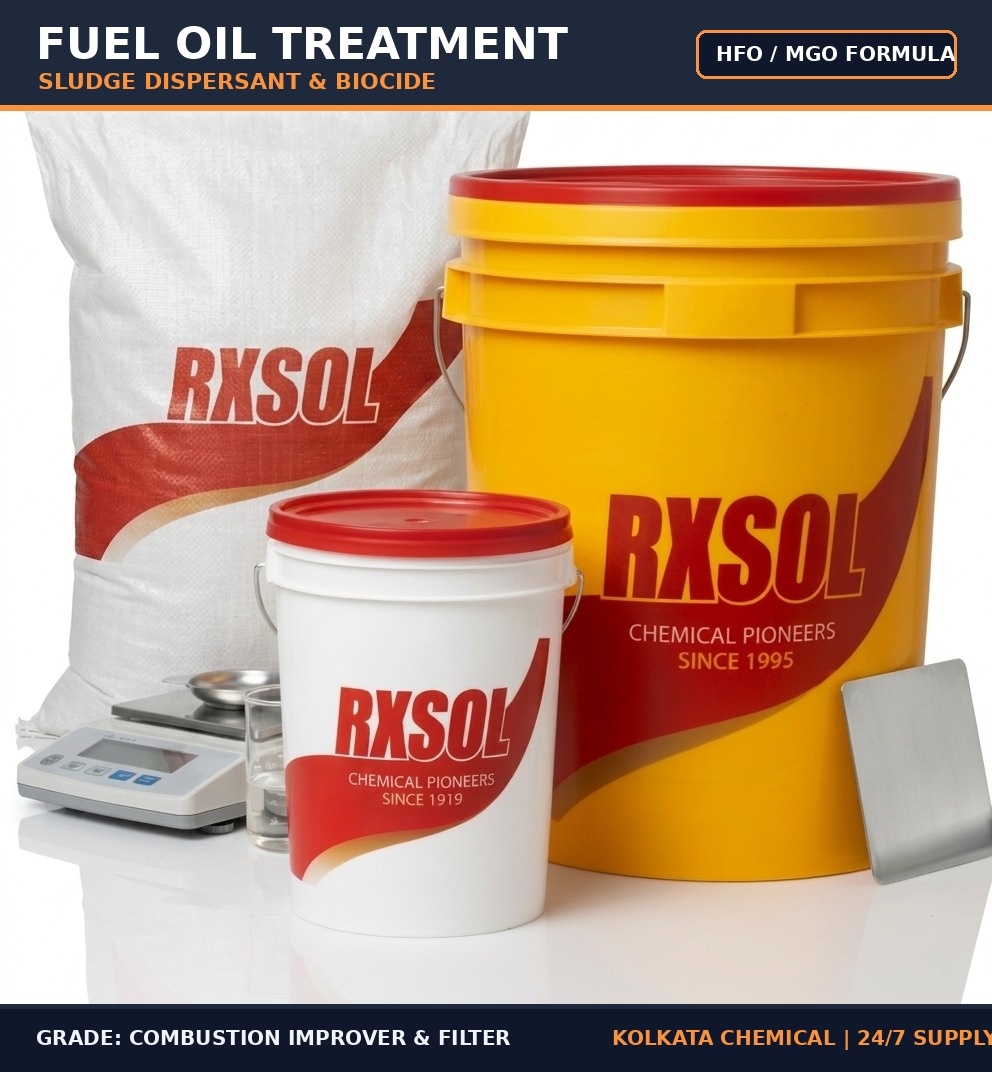
| Product Code | RXSOL-41-8977-025 |
Company Details:
RX MARINE INTERNATIONAL
105, A wing , BSEL , TECH PARK.
VASHI ,NEW BOMBAY 400703 INDIA
Branch : Kandla, Chennai, Mumbai, Vizag, Kolkata, Fujairah UAE, Muscat
| Phone | +91 22 27815540 / 41 / 42 |
| Fax | +91 22 2781 1318 :::AOH :0091 9821214367 |
| 123@rxmarine.com | |
| Website | www.rxmarine.com |

|
Component |
CAS No |
EC No. |
Weight % |
Classfication |
|
1,2,4-trimethyl benzene |
95-63-6 |
202-436-9 |
5-10 |
Flammable Liquid Category 3, Acute |
| Naphthalene | 91-20-3 | 202-049-5 | 25-1 | Carcinogenicity Category 2, |
|
Hydrocarbons; C10, Aromatics, >1% naphtalene |
64742-94-5* | 265-198-5 | 5-10 | Specific target organ toxicity - single exposure Category 3 (narcotic effects), |
|
Hydrocarbones, C10, aromatics, 1% naphtalene* |
Not Available | 918-811-1 | 50-70 | Specific target organ toxicity - single exposure Category 3 (narcotic effects), |

| Eye Contact |
If this product comes in contact with eyes: Wash out immediately with water. If irritation continues, seek medical attention. Removal of contact lenses after an eye injury should only be undertaken by skilled personnel. |
| Skin Contact |
If skin contact occurs: |
| Inhalation |
If fumes, aerosols or combustion products are inhaled remove from contaminated area. Other measures are usually unnecessary. |
| Ingestion |
Immediately give a glass of water. First aid is not generally required. If in doubt, contact a Poisons Information Centre or a doctor. If spontaneous vomiting appears imminent or occurs, hold patient's head down, lower than their hips to help avoid possible aspiration of vomitus. |

| NOTE TO PHYSICIANS | Treat by observation and supportive measures as indicated by the patients condition. |
| IF SWALLOWED | Rinse mouth. Do NOT induce vomiting (P301+P330+P331). Immediately call a POISON CENTER or doctor/physician (P310). Give water or milk to drink. Preferably with active carbon. |
| IF ON SKIN | Wash with plenty of soap and water (P302+P352). Take off contaminated clothing and wash before reuse (P362). |
| IF IN EYES | Rinse cautiously with water for several minutes. Remove contact lenses, if present and easy to do. Continue rinsing (P305+P351+P338). If eye irritation persists: Get medical advice/attention (P337+P313). |
| Most important symptoms and effects, both acute and delayed | In cases of severe exposure, headache may develop In cases of severe exposure, nausea/vomiting may develop Prolonged skin contact will result in defatting of the skin, leading to irritation, and in some cases, dermatitis Causes eye irritation (H320). The ingestion of significant quantities may cause chemical oedema |
| Indication of any immediate medical attention | No information available Treat symptomatically |

| Extinguishing media |
In case of fire: use carbon dioxide or dry agent for extinction (P370+P378) In case of fire: use dry powder/BCF for extinction (P370+P378) In case of fire: use dry sand or dry salt for extinction (P370+P378) |
| Special hazards arising from the substance or mixture | May form explosive mixtures with air In confined spaces, sewers, etc., the vapours may collect to form explosive mixtures with air Vapours are heavier than air and may travel considerable distances to a source of ignition and flashback In case of fire: (P370) .Carbon dioxide may be formed. Carbon oxides may be formed |
| Advice for firefighters | In the event of an adjacent fire, cool containers with water spray . Prevent run off water from entering drains if possible Wear chemical protection suit and positive-pressure breathing apparatus |

| Personal precautions, protective equipment and emergency procedures |
Wear protective clothing as per section 8. |
| Environmental precautions |
Avoid scattering in the environment Do not allow to enter public sewers and watercourses. |
| Methods for Containment and Clean Up |
Keep away from heat/sparks/open flames/hot surfaces. – No smoking (P210). Shut off all ignition sources Absorb spillage in earth or sand Absorb spillage in dry sand Absorb spillage in inert material and shovel up Place in sealable container Seal containers and label them Remove contaminated material to safe location for subsequent disposalVentilate the area and wash spill site after material pick-up is complete |
| Reference to other sections | See Section 13. |

| Precautions for safe handling | Avoid breathing dust/fume/gas/mist/vapours/spray (P261). Do not get in eyes, on skin, or on clothing (P262). Ensure adequate ventilation Eyewash bottles should be available Keep away from sources of ignition - No Smoking (S16) Use personal protective equipment as required (P281). Wash contaminated clothing before reuse (P363). Wash hands and working surfaces thoroughly after handling (P264). |
|
Conditions for safe storage, including any incompatibilities |
Store in a dry place. Store in a closed container (P402+P404). Store in a well-ventilated place (P403). |
| Specific end use(s) | Contact supplier for further information. |

| Engineering controls |
Engineering controls are used to remove a hazard or place a barrier between the worker and the hazard. Well-designed engineering controls can be highly effective in protecting workers and will typically be independent of worker interactions to provide this high level of protection. The basic types of engineering controls are: Process controls which involve changing the way a job activity or process is done to reduce the risk. |
| Eye and face protection | Safety glasses with side shields. Chemical goggles.Contact lenses may pose a special hazard; soft contact lenses may absorb and concentrate irritants. |
| Skin protection | See Hand protection below |
| Hands/feet protection |
Wear chemical protective gloves, e.g. PVC. Wear safety footwear or safety gumboots, e.g. Rubber The selection of suitable gloves does not only depend on the material, but also on further marks of quality which vary from manufacturer to manufacturer. Where the chemical is a preparation of several substances, the resistance of the glove material can not be calculated in advance and has therefore to be checked prior to the application. The exact break through time for substances has to be obtained from the manufacturer of the protective gloves and.has to be observed when making a final choice. |
| Body protection | See Other protection below |
| Other protection | Overalls. P.V.C. apron. |
Gloves Suit

| Physical State | Liquid |
| Odour | Characteristic |
| Odour Threshold | Not determined |
| pH | Not Applicable |
| Melting point/freezing point | Not Applicable |
| Boiling Point/Range | No data available |
| Flash point | ~62 |
| Evapouration rate | No information available |
| Flammability (solid, gas) |
Upper No data available Lower No data available |
| Vapour pressure | 0.1 |
| Vapour density | Not applicable Solid |
| Water Solubility | Immiscible |
| Relative density (Water = 1) | 0.9 |
| Partition coefficient; n-octanol/water | No Data Available |
| Autoignition Temperature | No Data Available |
| Decomposition Temperature | No Data Available |
| Viscosity | ~10 |
| Molecular weight (g/mol) | Not Available |
| Explosive Properties | Not determined |
| Oxidizing Properties | see section 2 |
| Surface Tension (dyn/cm or mN/m) | Not Available |
| Volatile Component (%vol) | Not Available |
| Gas group | Not Available |
| pH as a solution (1%) | Not Available |
| VOC g/L | Not Available |

| ReactiveHazard | This article is considered stable under normal conditions |
| Chemical stability | Considered stable under normal conditions |
| Possibility of hazardous reactions | No hazardous reactions known if used for its intended purpose |
| Conditions to avoid | Keep away from heat and sources of ignition |
| Incompatible materials | Not applicable |
| Hazardous decomposition products | Decomposition products may include carbon oxides. |

| Information on toxicological effects | LD50 (oral,rat) (Hydrocarbones) >2000 mg/kg |
| Contact with eyes | Causes irritation |
| Contact with skin | Prolonged skin contact will result in defatting of the skin, leading to irritation, and in some cases, dermatitis |
| Ingestion | Aspiration into the lungs may cause chemical pneumonia. |
| Inhalation | In cases of severe exposure, dizziness, confusion, headache or stupor may develop In cases of severe exposure, nausea/vomiting may develop |

| Toxicity | This product contains components which are classified in the EU as dangerous for the environment. |
| Persistence and degradability | Hydrocarbonsolvents expected to be inherently biodegradable. Oxidises rapidly by photo-chemical reactions in air. |
| Bioaccumulative potential | Hydrocarbon solvents have the potential to bioaccumilate. |
| Mobility in soil | Hydrocarbonsolvents floats on water. Adsorbs to soil and is not mobile. Partly evaporates from water and soil surfaces, but a significant portion will remain after one day. Large volumes may penetrate soil and could contaminate groundwater. |
|
Results of PBT and vPvB assessment |
Not a PBT according to REACH Annex XIII |
| Other adverse effects | Not applicable. |

|
Waste from Residues / Unused Products |
Disposal should be in accordance with local, state or national legislation Dispose of contents/container to an authorised waste collection point (P501) |
| Classification | EU Waste class: 07 01 04 |

Land transport (ADR)
| UN number | UN3082 |
| UN proper shipping name |
Environmentally hazardous substance, liquid, n.o.s. (Solvent naphta, heavy arom. mixture) |
| Hazard Class | 9 |
| Packing Group | III |
| Special precautions for user | No |
| Environmental hazards | Environmentally hazardous |
Air transport (ICAO-IATA / DGR)
| UN number | UN3082 |
| UN proper shipping name |
Environmentally hazardous substance, liquid, n.o.s. (Solvent naphta, heavy arom. mixture) |
| Hazard Class | 9 |
| Packing Group | III |
| Special precautions for user | No |
| Environmental hazards | Environmentally hazardous |
Sea transport (IMDG-Code / GGVSee)
| UN number | UN3082 |
| UN proper shipping name |
Environmentally hazardous substance, liquid, n.o.s. (Solvent naphta, heavy arom. mixture) |
| Hazard Class | 9 |
| Packing Group | III |
| Special precautions for user | No |
| Environmental hazards | Environmentally hazardous |
Inland waterways transport (ADN)
| UN number | UN3082 |
| UN proper shipping name |
Environmentally hazardous substance, liquid, n.o.s. (Solvent naphta, heavy arom. mixture) |
| Hazard Class | 9 |
| Packing Group | III |
| Special precautions for user | No |
| Environmental hazards | Environmentally hazardous |

| Safety, health and environmental regulations/legislation specific for the substance or mixture | 1,2,4-TRIMETHYL BENZENE IS FOUND ON THE FOLLOWING REGULATORY LISTS |
| Chemical safety assessment | No Chemical Safety Assessment has been carried out for this substance/mixture by the supplier. |

| Other Information |
The information above is believed to be accurate and represents the best information currently available to us. However, we make no warranty of merchantability or any other warranty, express or implied, with respect to such information, and we assume no liability resulting from its use. Users should make their own investigations to determine the suitability of the information for their particular purposes. In no event shall be liable for any claims, losses, or damages of any third party or for lost profits or any special, indirect, incidental, consequential or exemplary damages, howsoever arising, even if Rx Marine International has been advised of the possibility of such damages. DISCLAIMER OF LIABILITY :The information in this SDS was obtained from sources which we believe are reliable. However, the information is provided without any warranty, express or implied, regarding its correctness. The conditions or methods of handling, storage, use or disposal of the product are beyond our control and may be beyond our knowledge. For this and other reasons, we do not assume responsibility and expressly disclaim liability for loss, damage or expense arising out of or in any way connected with the handling, storage, use or disposal of the product. This MSDS was prepared and is to be used only for this product. If the product is used as a component in another product, this MSDS information may not be applicable. |