Anionic Polymer RXFLOC 124 is a powder form polyacrylamide based anionic polyelectrolyte. It consists of high negative charge. It is proficient in applications like solid-liquid separation in treatment of effluent water and mining.
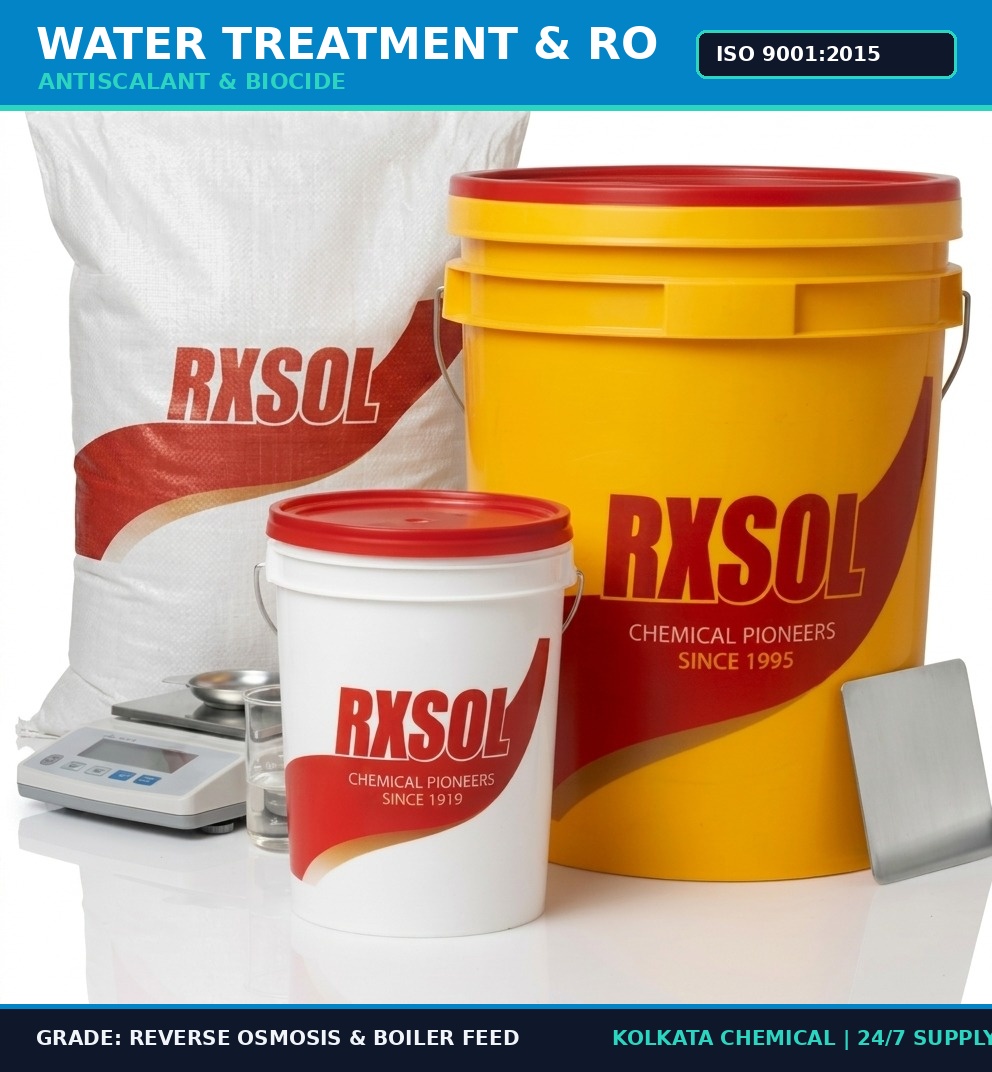
Anionic Polymer Rxfloc 124 / Anionic Polyelectrolytes, bearing negative charge, are adequately efficient for process applications like paper, sugar, textile, mining & food industries.
Anionic Polymer Rxfloc 124 / Polyelectrolytes have multiple applications some of as below:
- Polyelectrolytes are mainly used in water treatment processes, we can use them in water-treatment for sediment settling, and solid-liquid separation.
- In chemical reactions, polyelectrolytes are used as thickeners, emulsifiers and conditioners for influencing any reactants in any particular reaction.
- In daily life, we can find them in cosmetics, shampoos and soaps.
Theoretical dosage is 2 ppm (2mg per ltr) Actual dosage is determined using a jar test of treat water.
| Form | Solid |
| Colour | White |
| Odour | None |
| Odor Threshold | Not Applicable |
| pH | 6-8 |
| Melting Point | Not Applicable |
| Flash Point | >100°C |
| Autoignition temperature | >200°C |
| Vapour pressure (mm Hg) | 0.13 @ 20°C |

| Product Name | Anionic Polymer Rxfloc 124 |
| Part Number | RXSOL-40-4160-125 |
Company Details:
RX MARINE INTERNATIONAL
105, A wing , BSEL , TECH PARK.
VASHI ,NEW BOMBAY 400703 INDIA
Branch : Kandla, Hazira Surat, Mumbai, Chennai,Vizag, Kolkata, UAE, Oman, Nairobi KENYA
| Phone | +91 22 2087 1200 - 1400 |
| Fax | +91 22 27612100 :::AOH :0091 9821214367 |
| 123@rxmarine.com | |
| Website | www.rxmarine.com |

| Name of Substance | Cas Number | Wight % |
| Anionic type polyelectrolyte in powder form | 9003-05-8 | 100% |

| Signal Word | Not Applicable . Not Classified |
| Hazard Statements |
This chemical is not considered hazardous by the 2012 OSHA Hazard Communication Standard (29 CFR 1910.1200) Not a dangerous substance or mixture according to the Globally Harmonized System (GHS) |
| Hazards not classified (HNOC) | Not Applicable |
| Other hazards |
Not available |

| Eye Contact |
Check for and remove any contact lenses. In case of contact, immediately flush eyes with plenty of water for at least 15 minutes. Cold water may be used. Get medical attention. |
| Skin Contact | In case of contact, immediately flushes skin with plenty of water for at least 15 minutes while removing contaminated clothing and shoes. Cover the irritated skin with an emollient. Cold water may be used.Wash clothing before reuse. Thoroughly clean shoes before reuse. Get medical attention. |
| Inhalation: | Move to fresh air. If breathing is difficult, give oxygen. Get medical attention immediately if symptoms occur. |
| Ingestion: | Do not induce vomiting. Obtain medical attention.If vomiting occurs, lean patient forward or place on left side (head-down position, if possible) to maintain an open airway and prevent aspiration. |
| Notes to Physician | Treat symptomatically |

| Flammability | Not Flammable |
| Flash Point | Not Applicable |
| Suitable extinguishing media | Use extinguishing measures that are appropriate to local circumstances and the surrounding environment. |
| Hazardous combustion products | No data available |
| Protective Equipment | Use personal protective equipment. |
| Specific Hazards Arising from the Chemical | No Information Available |

| Spillage | Stop leak if you can do it without risk. Cover with plastic sheet to prevent spreading.Sweep up and shovel into suitable containers for disposal. Clean contaminatedsurface thoroughly. |
| Personal Protection | Ensure adequate ventilation. Use personal protective equipment. Avoid contact withskin, eyes and clothing. Avoid dust formation. Remove all sources of ignition. |
| Enviromental Precaution | Prevent further leakage or spillage. Prevent product fromentering drains. |
|
Methods for containment and cleaning |
Cover drains. Collect, bind, and pump off spills. Observe possible material restrictions. Take up dry. Dispose of properly. Clean up the affected area. Avoid generation of dust |

| Handling |
Provide sufficient air exchange and/or exhaust in work rooms. Avoid dust formation. All equipment usedwhenhandling the product must be grounded. Keep away from incompatible materials.Wear personal protective equipment. Avoid contact with skin, eyes and clothing. Keep away fromheat andsources of ignition. Do not ingest. Do not breathe dust. Handle in accordance with good industrial hygieneandsafety practice. |
| Storage | Keep container tightly closed in a dry and well-ventilated place. Store at room temperature in the original container |

| Engineering Control | Ensure adequate ventilation. Use process enclosures, local exhaust ventilation, or other engineeringcontrolstokeep airborne levels below recommended exposurelimits.If user operations generate dust, fume or mist, useventilation to keep exposure to airborne contaminantsbelow the exposure limit. | ||||||||||||||||||||||||
| Personal Protection |
Eye protection: Safety glasses with side-shields or Goggles Skin and body protection: Long sleeved clothing. Chemical resistant apron. Gloves. Respiratory protection: Effective dust mask. Hygiene measures: Avoid contact with skin, eyes and clothing. Wash hands before breaksandimmediately after handling the product. When using, do not eat, drink or smoke. |
||||||||||||||||||||||||
| Exposure Limit |
United State
|

| Form | Solid |
| Colour | White |
| Odour | None |
| Odor Threshold | Not Applicable |
| pH | 6-8 |
| Melting Point | Not Applicable |
| Flash Point | >100°C |
| Autoignition temperature | >200°C |
| Vapour pressure (mm Hg) | 0.13 @ 20°C |
| Flammability (solid, gas) | No Data Available |
| Explosive limits | No Data Available |
| Vapour pressure | No Data Available |
| Vapour Density | No Data Available |
| Bulk Density | No Data Available |
| Partition coefficient | No data available |
| Explosive properties | None |
| Solubility | Soluble in water |

| Stability | Product is stable, no hazardous polymerization occur. |
| Materials to avoid | Oxidizing agents may cause exothermic reactions. |
| Hazardous decomposition products | No decomposition if stored and applied as direct. Burning of the dried material can produce: hydrogen chloride gas, chloride gas, nitrogen oxides (Nox) & carbon oxides |

| Rout Of Entry | Inhalation. Ingestion. |
| Acute Toxicity Oral | LD50/oral/rat>5000 mg/kg |
| Acute Toxicity Dermal | The product is not considered toxic based on studies on laboratory animals. |
| Inhalation |
The product is not expected to be toxic by inhalation |
| Skin | May cause skin irritation with susceptible persons |
| Eye | Testing conducted on rabbits showed minor transient irritation which cleared within days |
| Sensitization | The product is not expected to be sensitizing |

| Eco Toxicity | The aquatic toxicity is high mitigated by the presence of dissolved organic carbon in the water. Results obtained using the US EPA “ Dirty Water “ test show that irreversible adsorption onto suspended matter and dissolved organics (such as humic and other organic acids) present in natural waters, reduces the toxicity to aquatic organisms by a factor of over 10. |
| Environmental fate | The product is rapidly eliminated from the aquatic medium through irreversible adsorption onto suspended matter and dissolved organics. |
| Products Biodegradation: | No Information available |
| Mobility in soil | No Information available |
| Other adverse effects | No Information available |

| Waste treatment Method | Waste material must be disposed of in accordance with the national and local regulations. |
|
Contaminated packaging |
Rinse empty containers with water and use the rinse water to prepare working solution. Can be landfilled or incinerated, in compliance with local regulations. |

| UN Number | Not Regulated. This product is not hazardous in any mode of transport. |
| Proper shipping name | The product is not covered by international regulation on the transport of dangerous goods |
| Transport hazard class(es) | |
| ADR/RID | Hazard class/division Not regulated |
| Subsidiary risk IMDG | Hazard class/division Not regulated |
| Subsidiary risk IATA | Hazard class/division Not regulated |
| Packing group | |
| Packing group | Not regulated |
| Environmental hazards | |
| Environmental hazards | No |
| Marine pollutant | No |
| ADR/RID | |
| Hazchem code | ADG 3Z |
| Tunnel Category | Not Reguted |
| IMDG | |
| EmS Code | Not Reguted |
| IATA | |
| Packing Instruction (Cargo) | Not Reguted |
| Maximum quantity | Not Reguted |
| Packing Instruction (Passenger) | Not Reguted |
| Maximum quantity | Not Reguted |

| Fedral State Regulation | This product is not federally regulated as a hazardous material. |
| Clean Air Act | No information is available. |
| Component Analysis | No information is available |
| DSCL (EEC) | This product is not regulated by any state as hazardous material. |

| Other Information |
The information above is believed to be accurate and represents the best information currently available to us. However, we make no warranty of merchantability or any other warranty, express or implied, with respect to such information, and weassume no liability resulting from its use. Users should make their own investigations to determine the suitability of the information for their particular purposes. In no event shall be liable for any claims, losses, or damages of any third party or for lost profits or any special, indirect, incidental, consequential or exemplary damages, howsoever arising, even if RX Marine International has been advised of the possibility of such damages.
DISCLAIMER OF LIABILITY :The information in this SDS was obtained from sources which we believe are reliable. However, the information is provided without any warranty, express or implied, regarding its correctness. The conditions or methods of handling, storage, use or disposal of the product are beyond our control and may be beyond our knowledge. For this and other reasons, we do not assume responsibility and expressly disclaim liability for loss, damage or expense arising out of or in any way connected with the handling, storage, use or disposal of the product. This MSDS was prepared and is to be used only for this product. If the product is used as a component in another product, this MSDS information may not be applicable.
|