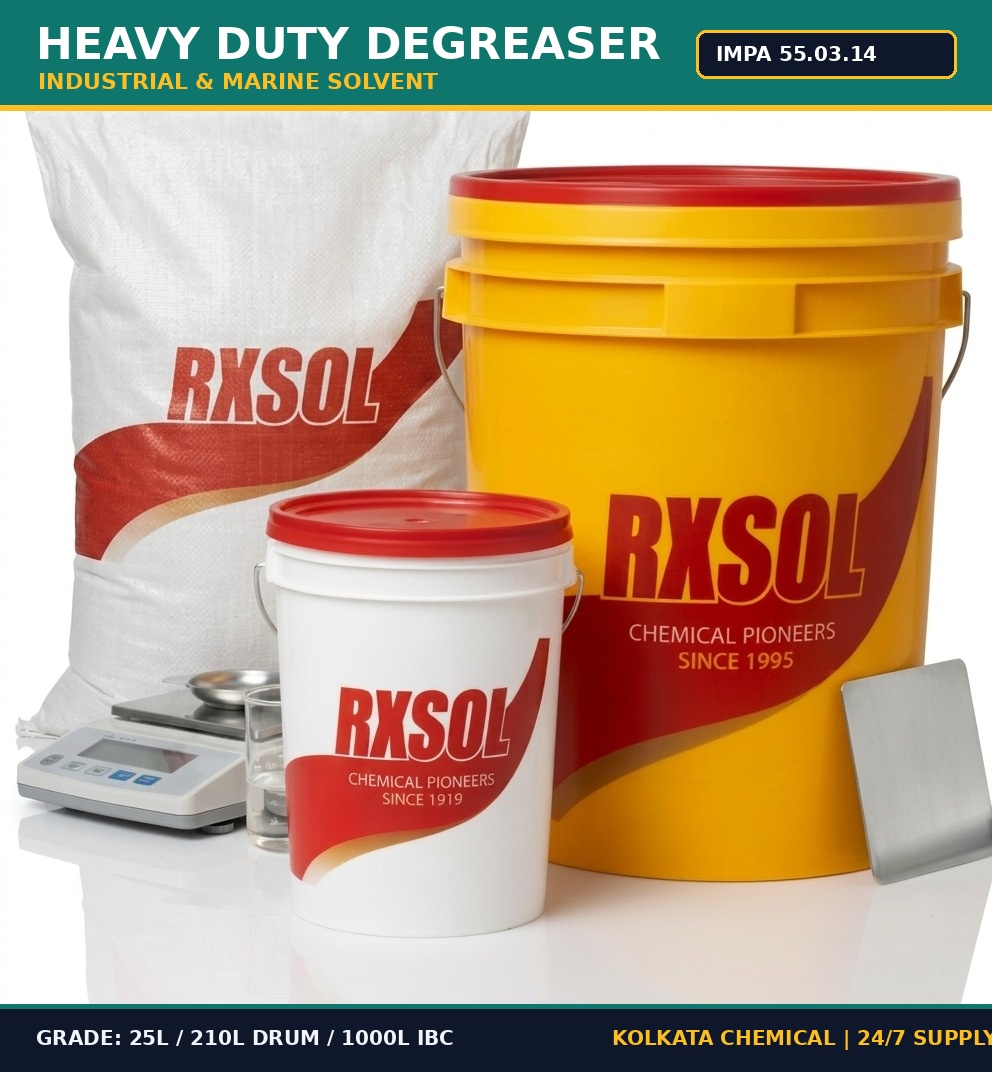
Very effective Alkaline Cleaner to clean Soil, grit, grime, buffing compound, slime, grease, oils, blood, tissue, salts, deposits, particulates, solvents, chemicals, radioisotopes, radioactive contaminations, silicon oils, mold release agents.
Application & Uses
Ultrasonic Alkaline Cleaner solutions is a very versatile chemical finding various applications. We have wide range of ultrasonic solutions.
RXSOL-16-3006-210 versatile, highly alkaline and water solvable solution used mainly for Mild Steel and Stainless Steel. It is specially used for removing the carbon, oil etc. using dipping method.
Dosage & Directions for Use
How to use
Healthcare instruments, laboratory ware, vacuum equipment, tissue culture ware, personal protective equipment, sampling apparatus, catheters, tubing, pipes, radioactive contaminated articles, optical parts, electronic components, pharmaceutical apparatus, cosmetics manufacturing equipment, metal castings, forgings and stampings, industrial parts, tanks and reactors. Also Suitable for cleaning engine components like fuel and Lube oil filters, Injection nozzles, pump components, inlet and exhaust valves & primarily refers to cleaning of hard surfaces, such as Decks, Tanks, Engine-rooms, etc. can be used for all types of cleaning and degreasing and may be applied by brush, handspray, high and low pressure washing machines etc.
Directions for Use and Dose Rates:- Soil, grit, grime, buffing compound, slime, grease, oils, blood, tissue, salts, deposits, particulates, solvents, chemicals, radioisotopes, radioactive contaminations, silicon oils, mold release agents.
Typical Cleaning : Make a fresh 1% solution (2 1/2 Tbsp. per gal., 1 1/4 oz. per gal. or 10 grams per liter) in cold, warm, or hot water. If available use warm water. Use cold water for blood stains. For difficult soils, raise water temperature and use more detergent. Clean by soak, circulate, wipe, or ultrasonic method. Not for spray machines, will foam. For nonabrasive scouring, make paste. Use 2% solution to soak frozen stopcocks. To remove silver tarnish, soak in 1% solution in aluminum container.
RINSE THOROUGHLY—preferably with running water. For critical cleaning, do final or all rinsing in distilled, deionized, or purified water. For food contact surfaces, rinse with potable water. Used on a wide range of glass, ceramic, plastic, and metal surfaces. Corrosion testing may be advisable.
General Cleaning:-RXSOL-16-3006-210 can be used for all types of cleaning & degreasing & may be applied by Brush, Hand spray, high and low pressure washing machines etc. Time necessary for cleaning depends on the nature and thickness of the deposits. 20-30 min. will suffice for most applications. Hardened, carbonised or aged deposits may require up to 4 hours.If the cleaning solution is not heavily contaminated, it may be re-used at a later stage. If allowed to cool, the de-gassing procedure must be repeated.Depending on degree of contamination RXSOL-16-3006-210 should be mixed with warm water at a rate of 50-200 ml per 10 litres. i.e. 1 cup of RXSOL-16-3006-210 to a bucket of water. RXSOL-16-3006-210 solution can be applied simply by mops, brushes or rags, or by dipping the soiled articles into the RXSOL-16-3006-210 solution. After cleaning, rinse off with cold or warm water.
Procedure for Use With Ultrasonic Equip:-Fill the ultrasonic unit chamber with approx. 30-35 litres of clean fresh water. During cleaning process , the ultrasonic bath must be de-gassed. Allow the bath to run for 1-2 minutes without any objects or cleaning agent until the evolution of gas bubbles ceases. This is to enhance the cleaning effect. Add 1 litre RXSOL-16-3006-210 For heavy stubborn deposits, a second litre may be added for rapid action.
Precaution:-To avoid foaming, make sure that the water is filled prior to adding RXSOL-16-3006-210 Best results are obtained at temperatures of 60-80°C. For general cleaning it may takes 15 –30 minutes while for Hardened, carbonised or aged deposits may require up to 4-6 hours.
Tank Cleaning:-Cargo tank cleaning to remove residues of Mineral, Animal, Vegetable or Fish oil, Waxes & Soot from inert gas systems.
Method of Application and Dose Rates:-Direct injection method for tank washing machines. Dose rate 1-5 litres per ton wash water (0.1-0.5%). Recirculation method. Dose rate 1-7 litres per ton wash water (0.1-0.7%).Spot cleaning. Hand spray neat or diluted with up to 5 parts water and leave for several minutes before rinsing off with clean water.
Cleaning of Cargo Tanks to Remove Soot from Inert Gas Systems:-Spray RXSOL-16-3006-210 on with a high pressure cleaning machine and use 1:6 with water. If used with hand sprayer, spray the product neat onto the surface, allowing 1 lit. for every 12 m2. Use a 5-8% solution in a tank washing machine. Leave for about 30-45 minutes. The surface should be kept wet. Wash down with hot water (80°C) and check the cargo tank.Repeat the procedure if necessary.
Note:-Whenever possible, the cleaning solution should be heated to 60-80°C. If this method is not possible, other conventional methods such as separate rate direct injection, recirulation or hand spraying provide acceptable options. For boiler fire side cleaning, a 10-20 % hot solution, (temp. above 40°C), should be sprayed on to the surfaces to be cleaned. Allow to penetrate for 20 minutes and flush off. For deposits which are very hard to remove, increase the concentration to 50% and repeat if necessary
Technical Specifications & Properties
| Parameters | Results | |
|---|---|---|
|
Appearance |
Colourless |
|
|
Density |
1.0 g/cm3 at 20°C |
|
|
Compatibility |
|
|
|
Metal |
May attack zinc, aluminium and magnesium at concentrated solutions |
|
|
Rubber |
No known effect |
|
|
pH neat |
12 |
|
|
Synthetic Rubber |
May swell |
|
|
Packaging |
RXSOL-16-3006-210 (25 Ltrs and 210 Ltrs) |
|
Recommended Industrial & Shipboard Areas
RXSOL offers a high-performance range of ultrasonic cleaners tailored for workshops, machine parts cleaning, electronics maintenance, laboratory tools, marine components, and more. Our advanced formulations ensure superior penetration, emulsification, and residue-free results without damaging delicate parts.
Featured Ultrasonic Cleaning Chemical for Workshops
Ultrasonic Cleaner
RXSOL-16-3006-025
Universal Bath Cleaner
RXSOL-16-3036-025
Ultrasonic Cleaner PD 400
RXSOL-26-8660-026
Ultrasonic Cleaner PD 450
RXSOL-26-8660-030
Ultrasonic Cleaner PD 200
RXSOL-37-8660-030
Available RXSOL Ultrasonic Cleaners
| Product Name | Product Code |
|---|---|
| Ultrasonic Cleaner | RXSOL-16-3006-025 |
| Ultrasonic Bath Universal Cleaner | RXSOL-16-3036-025 |
| ULTRASONIC CLEANER PD 400 | RXSOL-26-8660-026 |
| ULTRASONIC CLEANER PD 450 | RXSOL-26-8660-030 |
| Ultrasonic Cleaner PD 200 | RXSOL-37-8660-030 |
Wide Range of Ultrasonic Cleaning Solutions from RXSOL
Ultrasonic cleaning solutions can be essential when using an ultrasonic cleaner to achieve your desired results. RXSOL offers a versatile range of ultrasonic cleaning agents suitable for various industrial needs. Below are our recommended solutions:
- RXSOL-16-3006-025: Removes oil, rust, and prepares surfaces for painting. Safe for metals, polymers, rubber, and more.
- RXSOL-16-3006-210: Alkaline formula removes machining oils and soils; free from harmful solvents.
- RXSOL-16-3006-025 (MS & SS): Good for mild and stainless steel, prevents rusting.
- RXSOL-16-3006-210 (Carbon Removal): Strong carbon/oil remover via dipping.
- RXSOL-16-3006-025 (Brass & Copper): Gentle cleaner for non-ferrous metals.
- RXSOL-16-3006-025 (Neutral Cleaner): Concentrated, neutral cleaner for general industrial use.
- RXSOL-16-3006-025 (Degreaser Cum Deruster): Acidic mixture for degreasing and derusting at room temperature.
Applications
- Cleaning of precision mechanical parts and tools
- Automotive and workshop degreasing
- Medical, dental, and laboratory equipment cleaning
- Electronics: PCB and component cleaning
- Marine industry: removal of oil, carbon, and salt deposits
Application Method
- Prepare ultrasonic tank with water and add RXSOL cleaner (10%-20% depending on contamination level).
- Set the temperature (ideally 40–60°C for most parts).
- Activate the ultrasonic unit and immerse parts in the bath.
- Duration: Typically 15–20 minutes. Avoid overexposure of delicate items.
- Rinse with deionized or clean water and air-dry or use compressed air.
Benefits of RXSOL Ultrasonic Cleaners
- Penetrates complex geometries, blind holes, and narrow gaps
- Non-abrasive: no scratching or damage to sensitive surfaces
- Fast, effective, and reduces manual labor
- Biodegradable, low-foam, and low-toxic formulations
- Extends the life of cleaned components
Tips to Maximize Efficiency
- Use a degassed solution for maximum cavitation effect
- Maintain recommended temperature and concentration
- Regularly filter and change the cleaning solution
- Do not overload the ultrasonic tank – allow space for vibrations
- Use a suitable basket or tray – avoid direct contact with tank bottom
Why Choose RXSOL?
With decades of expertise in industrial cleaning, RXSOL delivers trusted chemical solutions for the most demanding environments. Our ultrasonic cleaners are specially engineered for high-performance, safety, and material compatibility — making them the preferred choice across marine, oilfield, laboratory, and manufacturing sectors.
Ultrasonic Cleaner Manufacturer Distributor in India
If you are looking for Ultrasonic Cleaner for your workshop or for cleaning, feel free to contact us directly. With our powerful solutions and your expertise, nothing will remain unclean. For Ultrasonic Cleaner in Oman, mail us
#UltrasonicCleanerManufacturer
#UltrasonicCleanerExporter
#UltrasonicCleanerSupplier
#UltrasonicCleanerforWorkshop
#BestUltrasonicCleanerforWorkshop
Product Description & Chemical Profile
RXSOL-16-3006-210 is a superior & powerful alkaline cleaner containing corrosion inhibitors to prevents the corrosion of metals . Concentrated, anionic detergent or manual and ultrasonic cleaning. Free rinsing to give you reliable results without interfering residues. Ideal for cleaning contaminants from glassware, metals, plastics, ceramic, porcelain, rubber and fiberglass. Excellent replacement for corrosive acids and hazardous solvents. It is low toxic product with an exceptional solvency power on soil & oily matter & having good foaming qualities. It is free from Hydrocarbon solvents, Biodegradable and minimizes the extreme hazards to personnel in handling materials .It is specially formulated for ultrasonic cleaning applications. Corrosion inhibited formulation recommended for glass, metal, stainless steel, porcelain, ceramic, plastic, rubber and fiberglass. Can be used on soft metals such as copper, aluminum, zinc and magnesium if rinsed promptly. Corrosion testing may be advisable.
Ultrasonic Alkaline Cleaning agent. Effectively and Intensive cleaner for the ultrasonic bath. RXSOL Ultrasonic Alkaline Cleaniner is blended with alkaline, demulsifying, concentrate. ULTRASONIC ALKALINE CLEANING SOLUTION is versatile, highly alkaline and water solvable solution used mainly for Mild Steel and Stainless Steel. It is specially used for removing the carbon, oil etc. using dipping method.
Need pricing, bulk volume, or vessel delivery today?
Send us your required quantity, chemical grade, delivery location, or vessel IMO number. Our technical chemical supply team replies within 1 hour.