Seawater dispersant is a highly effective dispersant for keeping seawater cooling system free from marine fouling. Keeping seawater cooling systems free from microbiological bacteria and fungi or macro biological.
Seawater dispersant SWD is a highly effective dispersant for keeping seawater cooling system free from marine fouling. Keeping seawater cooling systems free from microbiological (bacteria and fungi) or macrobiological (mussels, plants, etc.) growth is essential for maintaining the cooling capacity of today’s high efficiency systems. When used on a regular basis, DREWSPERSE SWD seawater dispersant prevents fouling by dispersing sea growth and preventing it from adhering to marine heat transfer equipment. DREWSPERSE SWD dispersant does not contain any phenolics, chlorinated solvents or other harsh chemicals.
It is recommended that the seawater cooling system be cleaned prior to beginning a prevention program featuring dispersant. The reason for cleaning is that if the cooling system is already fouled, the product will disperse new growth present but not existing growths.Therefore, to achieve the desired heat transfer condition,we recommend that all existing growth be removed.
Seawater dispersant may be dosed via a gravity head tank and flow-meter, an eductor dosing unit, or a suitable pump and tank system to a sea chest at the recommended concentration rate of 6 ppm for a period of one hour. To achieve 6 ppm, dose 0.6 liters of Seawater dispersant per 100 tons of water flow. Dosage should be for one hour. The best point for injection of the dilute solution of the product is immediately after the external sea chest COOLING WATER TREATMENT strainer. This provides total dispersion and mixing with the seawater. The mixed solution thus will contact all parts of the seawater cooling system

| Product Name | Seawater Dispersant SWD |
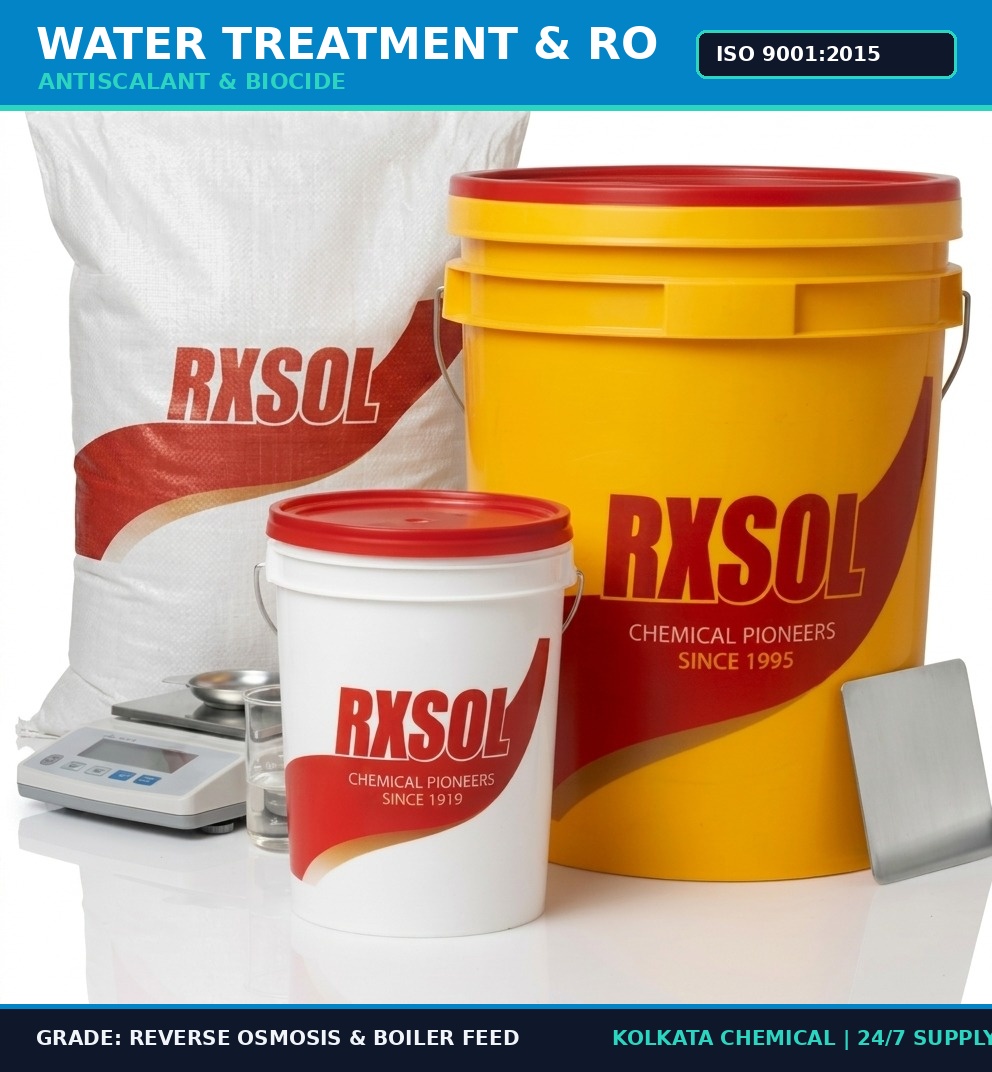
| Part Number | RXSOL-40-4003-026 |
Company Details:
RX MARINE INTERNATIONAL
105, A wing , BSEL , TECH PARK.
VASHI ,NEW BOMBAY 400703 INDIA
Branch : Kandla, Mumbai , Chennai, Vizag, Kolkata, UAE , OMAN , CANADA and KENYA
| Phone | +91 22 20871200 - 1400 |
| Fax | +91 22 27612100 :::AOH :0091 9821214367 |
| mail@rxmarine.com | |
| Website | www.rxmraine.com |

| Chemical Name | CAS | EC number | Weight |
| Quaternary ammonium compounds, benzyl-C12- 16-alkyldimethyl, chlorides | 68424-85-1 | 270-325-2 | >=10 - 15% |
| Methanol | 67-56-1 | 200-659-6 | >=0.1 - 0.5% |

| Hazard Summary | Irritant |
| Risks | Risk of serious damage to eyes. . |

| General advice | Consult a physician. Show this safety data sheet to the doctor in attendance |
| Eye Contact | Hold eyelids apart and flush eyes with plenty of water for at least 15 minutes. Get medical attention. Remove contact lenses. |
| Skin Contact | Take off contaminated clothing and shoes immediately. Wash off immediately with plenty of water. Wash contaminated clothing before re-use. If skin irritation persists, call a physician. |
| Inhalation | Move to fresh air. If symptoms persist, call a physician. In case of shortness of breath, give oxygen. |
| Ingestion | Do not induce vomiting without medical advice. Never give anything by mouth to an unconscious person. Consult a physician if necessary. |
| Hazards | Inhalation of high concentrations of this material, as could occur in enclosed spaces or during deliberate abuse, may be associated with cardiac arrhythmias. Sympathomimetic drugs may initiate cardiac arrhythmias in persons exposed to this material. |
| Treatment | No information available. |

| Suitable extinguishing media | ABC powder, Water mist, Carbon dioxide (CO2), Dry chemical. |
| Unsuitable extinguishing media | Halons. |
|
Hazardous combustion products |
Carbon dioxide and carbon monoxide. |
| Personal protective equipment | In the event of fire, wear self-contained breathing apparatus. Use personal protective equipment. |
| Thermal decomposition | No data available |
| Precautions for fire-fighting | Keep containers and surroundings cool with water spray. |

| Personal precautions | Persons not wearing protective equipment should be excluded from area of spill until clean-up has been completed. |
| Environmental precautions | Prevent further leakage or spillage if safe to do so. No special environmental precautions required. |
| Methods for cleaning up | Large spills should be collected mechanically (remove by pumping) for disposal. Keep in suitable, closed containers for disposal. |
| Other information | Comply with all applicable federal, state, and local regulations. |

| Handling | Avoid formation of aerosol. Do not breathe vapours or spray mist. For personal protection see section 8. Provide sufficient air exchange and/or exhaust in work rooms. Avoid exceeding of the given occupational exposure limits (see section 8). Smoking, eating and drinking should be prohibited in the application area. Normal measures for preventive fire protection. |
| Storage | Store in original container. Keep containers tightly closed in a dry, cool and well-ventilated place. Stable under recommended storage conditions. Protect from frost. |

Exposure Guidelines
| MAC (NL) | time weighted average | 200 ppm |
| MAC (NL) | time weighted average | 260 mg/m3 |
| MAC (NL) | Short term exposure limit | 400 ppm |
| MAC (NL) | Short term exposure limit | 520 mg/m3 |
| EU ELV | time weighted average | 200 ppm |
| EU ELV | time weighted average | 260 mg/m3 |
| General advice | These recommendations provide general guidance for handling this product. Personal protective equipment should be selected for individual applications and should consider factors which affect exposure potential, such as handling practices, chemical concentrations and ventilation. It is ultimately the responsibility of the employer to follow regulatory guidelines established by local authorities. Keep away from food, drink and animal feedingstuffs. When using do not eat, drink or smoke. Ensure that eyewash stations and safety showers are close to the workstation location. |
| Exposure controls | Provide sufficient mechanical (general and/or local exhaust) ventilation to maintain exposure below level of overexposure (from known, suspected or apparent adverse effects). |
| Eye protection | Safety glasses with side-shields |
| Skin and body protection | Wear as appropriate: Safety shoes Wear resistant gloves such as: Nitrile rubber |
| Respiratory protection | When workers are facing concentrations above the exposure limit they must use appropriate certified respirators |

| Physical state | Liquid |
| Colour | No data available |
| Odour | Clear |
| Odor Threshold | Not Applicable |
| pH | (+/- 0.7) 7.8 |
| Melting Point | Not Applicable |
| Boiling Point | 64.70 °C |
| Flash Point | Not Applicable |
| Evaporation Rate | (>) 1 (Ethyl Ether) |
| Flammability (solid, gas) | No data available |
| Explosive limits | No Data Available |
| Upper/lower flammability or explosive limits | 3.3 %(V) / |
| Autoignition temperature | Not Applicable |
| Decomposition temperature | No data available |
| Vapour pressure | 169.31 hPa @ 25 °C |
| Density | 0.989 g/cm3 @ 77 °F / 25 °C |
| Vapour Density | Not Applicable |
| Relative Density | (>) 1 (AIR=1) |
| Freezing point | No data available |
| Specific Gravity | No data available |
| Partition coefficient | Not Applicable |
| Explosive properties | No data available |
| Solubility | Not Applicable |
| Ignition temperature | No information available. |
| Particle characteristics | No data available |

| Reactivity | No data available |
| Stability | No hazards to be specially mentioned |
| Possibility of hazardous reactions | Violent reactions possible with: Oxidizing agents Strong acids halogens Strong bases |
| Conditions to avoid | None known. |
| Incompatible materials | Strong oxidizing agents |
| Hazardous decomposition products | Carbon dioxide and carbon monoxide |
| Hazardous reactions | Hazardous polymerisation does not occur. |

| Exposure routes | Skin contact, Eye Contact, Ingestion, Inhalation |
| Eye contact | Causes serious eye irritation |
| Skin contact | May irritate skin.According to the classification criteria of the European Union, the product is not considered as being a skin irritant. |
| Ingestion | Not known to be harmful if swallowed. |
| Inhalation | Not known to be harmful if inhaled. |
| Aggravated Medical Condition | Preexisting disorders of the following organs (or organ systems) may be aggravated by exposure to this material: Skin, lung (for example, asthma-like conditions), Liver, Central nervous system, male reproductive system, Individuals with preexisting heart disorders maybe more susceptible to arrhythmias (irregular heartbeats) if exposed to high concentrations of this material. |
| Symptoms | Signs and symptoms of exposure to this material through breathing, swallowing, and/or passage of the material through the skin may include: stomach or intestinal upset (nausea, vomiting, diarrhea), irritation (nose, throat, airways), Cough, central nervous system depression (dizziness, drowsiness, weakness, fatigue, nausea, headache, unconsciousness), Lack of coordination, confusion, irregular heartbeat, respiratory failure, coma |
| Target Organs | May cause damage to organs through prolonged or repeated exposure. - Kidney |
| Acute oral toxicity | The substance/mixture does not contain components considered to have endocrine disrupting properties according to REACH Article 57(f) or Commission Delegated regulation (EU) 2017/2100 or Commission Regulation (EU) 2018/605 at levels of 0.1% or higher. Repeated dose toxicity - Rat - male and female - Oral - 90 d - NOAEL (No observed adverse effect level) - 3.000 mg/kg Remarks: Subchronic toxicity RTECS: KN5250000 Nausea, Vomiting, Dizziness, Central nervous system depression, Aspiration or inhalation may cause chemical pneumonitis., MTBE (methyl-tert-butyl ether) is reported to metabolize to tert-butyl alcohol and formaldehyde by microsomal demethylation, MTBE (methyl-tertbutyl ether) should be considered a "potential human carcinogen" due to an increase in leydig interstitial cell tumors of testes in male rats and an increase in lymphomas, leukemias, and uterine sarcomas in female rats., In another unpublished study MTBE was shown to be carcinogenic due to "increased incidence of a rare type of kidney tumor" in male rats and an "increase in the incidence of hepatocellular adenomas" in female mice. To the best of our knowledge, the chemical, physical, and toxicological properties have not been thoroughly investigated. |
| Acute dermal toxicity | Quaternary ammonium compounds, benzyl-C12-16- alkyldimethyl, chlorides no data available Methanol LD 50 Rabbit: 12,800 mg/kg |

| Biodegradation | No data available |
| Bioaccumulative potential | The bioaccumulation potential cannot be determined. |
| Component data Methanol (CAS 67-56-1) | 48 h EC 50 Water flea (Daphnia magna) Static: > 10,000 mg/l |

| European Waste Catalogue | The Waste code should be assigned in discussion between the user and the waste disposal company. |
| Empty packaging | Empty remaining contents. Dispose of as unused product. Empty containers should be taken to an approved waste handling site for recycling or disposal. Do not re-use empty containers. Do not burn, or use a cutting torch on, the empty drum. |
| Waste treatment Method | No data available |

| UN number | ADR/RID: IMDG: IATA: |
| UN proper shipping name | ADR/RID: IMDG: IATA: |
| Transport hazard class(es) | ADR/RID: IMDG: IATA: |
| Packaging group | ADR/RID: IMDG: IATA: |
| Environmental hazards | ADR/RID: No IMDG: No IATA: No |
| Special precautions for user | Tunnel restriction code : (C/E) |
| Further information | Not classified as dangerous in the meaning of transport regulations. |

| Product Use Description | No data available |
| Hazard symbols | Irritant |
| R-phrase(s) R41 | R41 Risk of serious damage to eyes. |
| S-phrase(s) S23 | S23 Do not breathe vapour.S26 In case of contact with eyes, rinse immediately with plenty of water and seek medical advice. S39 Wear eye/face protection. S51 Use only in well-ventilated areas. S60 This material and its container must be disposed of as hazardous waste. |

| Other Information |
The information above is believed to be accurate and represents the best information currently available to us. However, we make no warranty of merchantability or any other warranty, express or implied, with respect to such information, and weassume no liability resulting from its use. Users should make their own investigations to determine the suitability of the information for their particular purposes. In no event shall be liable for any claims, losses, or damages of any third party or for lost profits or any special, indirect, incidental, consequential or exemplary damages, howsoever arising, even if Rx Marine International has been advised of the possibility of such damages. DISCLAIMER OF LIABILITY :The information in this SDS was obtained from sources which we believe are reliable. However, the information is provided without any warranty, express or implied, regarding its correctness. The conditions or methods of handling, storage, use or disposal of the product are beyond our control and may be beyond our knowledge. For this and other reasons, we do not assume responsibility and expressly disclaim liability for loss, damage or expense arising out of or in any way connected with the handling, storage, use or disposal of the product. This MSDS was prepared and is to be used only for this product. If the product is used as a component in another product, this MSDS information may not be applicable. |