RX JELLY Pickling Paste
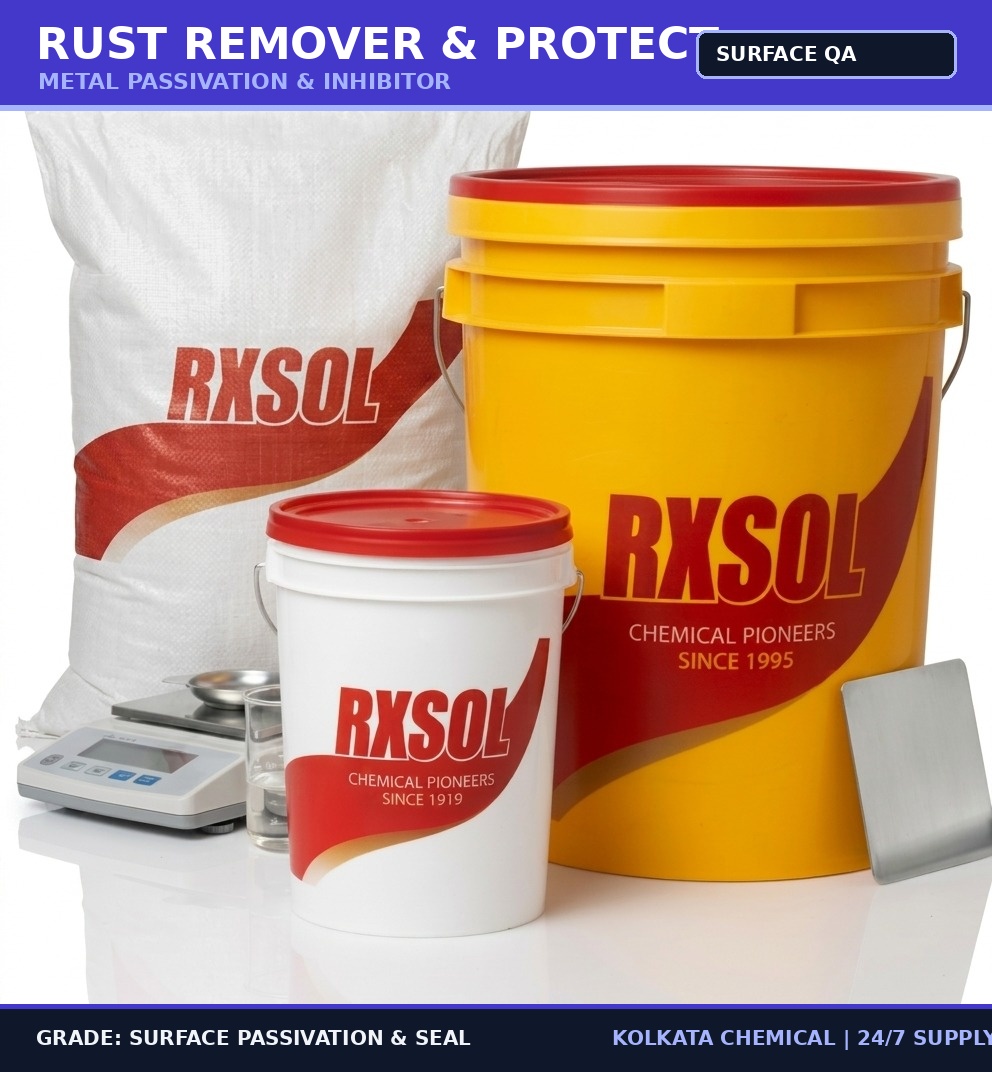
Passivating Pickling Paste is highly concentrate paste which is used to clean weld seams and surrounding areas and is applied with brush. This is very effective product to acts as Degreasing, cleaning, pickling and passivation.
Category

RX JELLY Paste is highly concentrate paste which is used to clean weld seams and surrounding areas and is applied with brush. This is very effective product to acts as Degreasing, cleaning, pickling and passivating of austenitic and duplex stainless steel 304, 316, nickel and aluminium. 

Strong adhesion on inclined and vertical surface

For local pickling and cleaning all types of welds. Remains active with temperatures >10°C 

Degrease thoroughly the surface with RXSOL-10-1005-025 . Never let the product dry. Hose off completely and thoroughly with a high-pressure spraying pistol. Remaining grease and product will influence the pickling process adversely. Let the surface dry, rub dry or blow dry.

Stir the pickling paste. Spread the undiluted paste over the surface or the weld by using the supplied acid resistant brush.

Contact time: 30 min to 2 h. (depending on the kind of weld, the room temperature and material).The pickling process is terminated as soon as the paste turns green. Always rinse abundantly with clean water. Rinse preferably with demineralised water.

Never let the product dry Prolonged pickling lead to accelerated corrosion sensitivity and damages the passivation process

In case of doubt, try out on a test surface or contact our technical service. 

Application

It is used to remove heavy scales, discolouration, annealing colours, rust particles near weld and welding affected area by heat without grinding or wire brushing or buffing.

Coverage : Approx. 100 meters of running weld seam / kg of Passivating Pickling Paste

PROBLEM CLEARING AGENT COMMENTS
Rust and other corrosion products. Embedded or adhering "free iron Very light rust stain can be removed by 10% nitric acid. More significant rust or embedded iron will require picking. See also previous sections on Passivating and Picking. Sand or glass-bead blasting is another option Wear PPE as appropriate. Afterwards rinse well with clean water. Mix in acid-proof container, and be very careful with the acid, (See Precautions for acid cleaners)
Routine cleaning of boat fittings. Frequent washing down with fresh water. Recommended after each time the boat is used in salt water.
Cooking pot boiled dry. Remove burnt food by soaking in hot water with detergent, baking soda or amonia. Afterwards clean and polish. with a mild abrasive if necessary. See comments re steel wool.
Dark oxide from welding or heat treatment. "Picking Paste" or picking solutions given on previous page. Must be careful rinsed, and use care in handling (see Precautions for acid cleaners).
Scratches on polished (satin or brushed) finish. Slight scratches - use impregnated nylon pads. Polish with polishing wheel dressed with iron-free abrasive for deeper scratches. Follow polish lines. Then clean with soap or detergent as for routine cleaning Do not use ordinary steel wool - iron particles can become embedded in stainless steel and cause further surface problems. Stainless steel and "Scotchbrite" scouring pads are satisfactory.


PROBLEM CLEARING AGENT COMMENTS
Routine cleaning All finishes Soap mild detergent and water. (preferably warm) Sponge, rinse with clean water, wipe dry if necessary. Follow polish lines.
Fingerprints All finishes Soap warm water or organic solvent (eg acetone, alchol, methylated spirits) Rinse with clean water and pipe dry. Follow polish lines.
Stubborn stains and discoloration. All finishes. Mild cleaning solutions. Ensure any properietary cleaners state compatibility with stainless steel. Phpsphoric acid cleaners may also be effective Use rag, sponge or fibre brush (soft nylon or natural bristle. An old toothbrush can be useful). Rinse well with clean water and wipe dry. Follow polish lines.
Lime deposits from hard water. Solution of one part vinegar to three parts water. Soak in solution then brush to loosen. Rise well with clean water.
Oil or grease marks. All finishes. Organic solvents (eg. acetone, alchol, methylated spirits, proprietary "safety solvents"). Baked-on grease can be softened beforehand with ammonia Clean after  with soap and water, rinse with clean water and dry. Follow polish lines
 
Dose

1.Passivating Pickling Paste is applied on weld seam & surrounding areas with a nylon bristled plastic brush. Application Temp. = between 5 – 40 deg. C


2. Keep Passivating Pickling Paste for 5 to 30 minutes (contact time) depending on contamination, temperature & grade of Stainless Steel.


3. Use pressurised water jet spray OR wipe the weld seam lightly with plastic brush & wash with water thoroughly.

For Satin / Dull Finish

1. First remove oil, dirt,buffing compounds etc, with Rxsol  Degreaser. Add 50-75 gm/lit. in water (i.e. 1 kg Rxsol Degreaser in 15 to 20 lit. water) & stir to dissolve. Wipe S.S surface with cotton cloth or pressurized spray for 2-5 min. or soak for 10 min. Then, wash with water properly.

2. Passivating Pickling Paste is applied on weld seam & surrounding areas with a nylon bristled plastic brush or  by Paste sprayer or circulated in pipeline with pump.

Application Temp. = Room temp.( i.e. between 25-35 C). If temperature is less than 25 C, then more time may be required and if temperature is more than 35 C, then uneven preocessing & drying of applied materials may result.Then, cool SS equipment by keeping it in shade or cover by temporary shade to protect that not directly under the sun light.

3. Keep Passivating Pickling Paste for 10-45 minutes depending on contamination & scale. (Passivating Pickling Paste generally kept for 10-30 min. and Pickling Spray generally kept 30-45 min. Depending on SS type and initial condition of SS parts)

4. Wipe the weld seam lightly with plastic brush or cloth & wash the Passivating Pickling Paste applied area with water thoroughly.

5.Spray or Dip in Passivate 1  or  Passivate - 2 Solution & leave it for 15-25 minutes. Rinse with water thoroughly. ( Steps 1 & 5 can be avoided for Passivating Pickling Paste  on weld seam application)


For passivating Mirror Bright SS Areas

THE BELOW STEPS WILL NOT AFFECT SHINE OF MIRROR BRIGHT POLISHED SS AREAS AND PROVIDE CONTAMINATION & STERILE PARTICLE FREE PASSIVATED SS SURFACE.

1) First apply Passivating Pickling Paste in weld seam & surrounding areas with a nylon bristled plastic brush. After 10 to 30 min. wipe with cloth or plastic brush & wash water thoroughly.

(Application of Passivating Pickling Paste ensures that black & red spots do not come on & near weld seams area as generally observed some days after bright buffing.)

2) Complete bright buffing / polishing procedure to make surface mirror bright & shiny.

DISCARD STEPS 1 & 2 ABOVE, IF SS SURFACE IS ALREADY BRIGHT BUFFED OR ELECTROPOLISHED.

3) Remove oil, dirt buffing compounds etc. with RXSOL Degreaser which is Metal Free Degreaser. Add 50-75 gm/lit. in water & stir to dissolve.

Wipe S.S. surface with cotton cloth or pressurised spray for 2-5 min. or soak small parts for 10 min. Wash with water prpoerly.

4) Spray or Dip in  Passivate - 1 or  Passivat -2 & leave it for 15-25 minutes. then rinse with water thoroughly.

NOTE: It is better to rinse SS surface with 10 gm/lit RXSOL DEGREASER solution as the last step and then rinse with water to ensure complete removal of previously applied Passivate Pickling paste or spray from the surface.

Technical specifications

- Appearance: Liquid, viscous, colourless, soluble in water

- pH <1.5 at 1 % concentration

- Boiling point - not known

- Vapour pressure <0.01 kPa at 20 deg C

- Vapour density - not known

- Freezing point <0 °C at 760 mm/Hg

- Completely soluble in water

- Relative density (20°C):  1.352
-Flash point, °C:

- Boiling point/range, °C: 100 – 120
- Melting point/range, °C: 0
- Vapour pressure, Pa (20°C): 2332
- Solubility in water :completely soluble 


Note

stainless steel weld joint cleaner

Advantage & Benifit

  • Easy to apply.
  • Due to paste easy to use on vertical surface.
  • Simply washed with water.
  • Easy to handle.
  • Easly  remove heavy scales, discolouration, annealing colours, rust particles near weld and welding affected area.
    Non-toxic pickling paste
    The emission of nitrous gases is limited due to addition of special ingredients.
    Remains active with temperatures >10°C
    Strong adhesion on inclined and vertical surfaces.
    Fast-working.
    Very efficient.
    Economical.
    Practical to use.
    Passivation occurs automatically within 24h by exposing to the air.
    Ready for use. Doesn’t have to be coloured in.
    The tensio-active substances used are over 90% biodegradable according to OECD standards. 
Remarks / Precaution

Helps to clean Stainless Steel Castings & Welded Components.

Packing sizes
Stainless Steel Castings & Welded Components cleaner available in 1 Kgs, 5 Kgs.
MSDS

Product Name RXSOL-68-6801-005
Product Type Passivating Pickling Paste

Company Details:

RX MARINE INTERNATIONAL
105, A wing , BSEL , TECH PARK.
VASHI ,NEW BOMBAY 400703 INDIA

Stock Point : Mumbai, Gandhidham, Chennai, Visakhapatnam, Kolkata, Fujairah, Muscat

Phone +91 22 65113333 / 5555 / 9999
Fax +91 22 2781 1318 :::AOH :0091 9821214367
Email mail@rxmarine.com

Chemical Name Concentration    CAS Number EC Number R Phrases  Symbols
Nitric acid 10-25 7697-37-2 231-714-2  8, 35 O, C
Hydrogen fluoride 2-6 7664-39-3 231-634-8 26/27/28, 35   T+, C

Ammoniumhydrogene difluoride 

2.5 -10 - - 25 - 34 C, T
Proprietory Ingredients 10 - 25 - - - -

Odour: Unpleasant odour

Appearance: Liquid, viscous, colourless, soluble in water

Contact with eyes: Corrosive to eyes

Contact with skin: Causes burns (R34), Toxic by inhalation, in contact with skin and if swallowed (R23/24/25)

Ingestion: Can cause damage to the stomach lining

Contact with skin

- Remove contaminated clothing immediately and drench affected skin with plenty of water. Then wash with soap and water
- Seek medical attention if irritation persists. Use Calcium Gluconate solution / gel for treating any external body part.

Rinse skin with plenty of water and if possible with a calcium gluconate gel 10%. Transport immediately to hospital


Contact with eyes
- If substance has got into eyes, immediately wash out with plenty of water for at least 15 minutes , act fast, rinse immediately with plenty of water and seek medical attention.
- Irrigate eyes thoroughly whilst lifting eyelids
- Seek immediate medical attention
Ingestion - Do not induce vomiting
- Give plenty of water to drink
- Use appropriate antacid
- Never give anything by mouth to an unconscious person
- Seek immediate medical attention
Inhalation
- Inhalation is unlikely to occur
- Remove patient to fresh air
- Never give anything by mouth to an unconscious person
- Give plenty of water to drink
- Obtain immediate medical attention
General - In case of accident or if you feel unwell, seek medical advice immediately (show the label where possible) (S45)

Always ask medical advice as soon as possible should serious or continuous disturbances occur
Skin contact : remove contaminated clothing, 
Eye contact : rinse first with plenty of water and seek medical attention
Ingestion : have mouth rinsed and take to hospital immediately
Inhalation : in case of serious or continous discomforts: remove to fresh air and seek medical attention 

- Non combustible passivating paste is a strong oxidizing agent. Strong oxidizer foam CO2, dry powder, fog spray to cool control the fire involve. Do not use water jets 

- Smoke from fires is corrosive, Nitrogen oxides may be formed
- Not flammable. In case of fire use extinguishing media appropriate to surrounding conditions
- Smoke from fires is corrosive. Take precautions to protect personnel from exposure

Personal Precautions
- Wear protective clothing as per section 8, Self-contained breathing apparatus, safety gloves and shoes/boots should be worn whenhandling containers 
Environmental Precautions - No special precautions are required for this product
- Do not flush spilt material into any public water system
Immediate Actions - Shut off source of leak if safe to do so
- Use appropriate containment to avoid environmental contamination (S57)
Clean Up Actions - Absorb spillage in inert material and shovel up
- Ventilate the area and wash spill site after material pick-up is complete

Special Precautions
- Wear protective clothing as per section 8
- Do not use metal containers for spilled liquid

Handling - Wear protective clothing as per section 8
- Avoid contact with skin and eyes (S24/25)
- Eyewash bottles should be available

Acid-corrosive. Exercise care in the choice with metals and reactive substances. Store only in original containers. Ensure good housekeeping. STORE AWAY FROM ORGANIC PIGMENTS AND CHEMICALS 

Storage - Keep only in the original container in a cool, well ventilated place (S3/9/49)
- Opened containers should be carefully resealed and stored in an upright position
- Recommended storage temperature between 5 and 40 °C

Shelf life:  One year in unopened bottle correctly stored

Exposure Limits - TLV (TWA) 5 mg/m3 (Nitric acid)
- STEL 2.5 mg/m3 (Hydrogen fluoride)

Exposure controls
- The undiluted product must not be used in a confined space without good ventilation
Occupational exposure controls - Where an air-purifying respirator is suitable, use EN141 or EN405, type B
- Wear face mask giving complete face protection
- Wear suitable clothing providing resistance to acids
- Wear plastic or rubber gloves

Visor                     Gloves                   Suit                      Respirator

- Odour: Unpleasant pungent odour

- Appearance: Liquid, viscous, colourless, soluble in water

- pH 1 at 1 % concentration

- Boiling point - not known

- Vapour pressure 0.01 kPa at 20 deg C

- Vapour density - not known

- Freezing point 0 °C at 760 mm/Hg

- Completely soluble in water

- Specific gravity (water=1) 1.2 - 1.3

- Non combustible

- Viscosity ~ 2000 mPa.s at 20 deg C

- No hazardous reactions known if used for its intended purpose

- Avoid overheating, Avoid contact with alkalis (strong bases)

- Contact with alkali metals liberates flammable gas, Incompatible with alkalis (strong bases)

- See Section 5, Decomposition products may include nitrogen oxides

- Contact with nitrite (e.g. Diesel DEWT Guard NB NB, ROCCORRX NB Liquid) liberates toxic gas.

Toxicological information
- LD50 (oral,rat) 680 mg/kg

Inhalation
- Can cause damage to the respiratory system

Contact with skin
- Causes burns (R34)

Contact with eyes
- Causes burns (R34)

Ingestion
- The ingestion of significant quantities may cause damage to digestive system

Carcinogenicity
- No evidence of carcinogenic effects

Ecotoxicity
- May cause acute effects in the aquatic environment
- This product does not contain ingredients which are classified in the EU as dangerous for the environment.

Mobility
- Completely soluble in water

Persistence and Biodegradability
- Its main ingredients will either dissolve rapidly and dissociate in water or are readily/inherently biodegradable.

Bioaccumulation Potential
- Bioaccumulation of the components in this product is insignificant.

Other Adverse Effects
- No environmental problems are expected when the product is used / handled correctly. In its intended use, the product will not be released into the environment.
- Presents little or no hazard to the aquatic environment

Classification
- EU Waste class: 06.01
- This material and/or its container must be disposed of as hazardous waste

Disposal considerations
- Do not discharge into drains or the environment, dispose to an authorised waste collection point
- Disposal should be in accordance with local, state or national legislation

Proper Shipping Name: HYDROFLOURIC ACID

Proper Shipping Name: Corrosive liquid, toxic, n.o.s. (Hydrofluoric acid, Nitric acid, mixture)
UN No.: 2922
Hazard Class: 8           Packing Group: II

Road/Rail (ADR/RID)
Proper Shipping Name: Corrosive liquid, toxic, n.o.s. (Hydrofluoric acid, Nitric acid, mixture)
ADR UN No.: 2922
ADR Hazard Class: 8 Tremcard: 80S2922-II

UN No. 2031 

IMO class 8 
EA code 154 
Hazchem code 2(x) 
Kemler 80 
Packing group 11 
ERG NO 154 

Sea (IMDG)
Proper Shipping Name: Corrosive liquid, toxic, n.o.s. (Hydrofluoric acid, Nitric acid, mixture)
IMDG UN No.: 2922
IMDG Hazard Class.: 8 IMDG Pack Group.: II
IMDG EmS: F-A, S-B IMDG subrisk: 6.1
IMDG Labels: 8, 6.1 IMDG Flashpoint: N/A

Air (ICAO/IATA)
Proper Shipping Name: Corrosive liquid, toxic, n.o.s. (Hydrofluoric acid, Nitric acid, mixture)
ICAO Un No.: 2922
ICAO Hazard Class.: 8 ICAO Packing Group.: II
ICAO subrisk: 6.1 ICAO Labels: 8,6.1, CAO
ICAO Flashpoint: N/A

DOT / CFR (US Department of Transportation
DOT Proper Shipping Name: Corrosive liquid, toxic, n.o.s. (Hydrofluoric acid, Nitric acid, mixture)
Hazardous Material: Hydrofluoric acid, Nitric acid
Hazard Class: 8 Identification Number: UN 2922
Product RQ (lbs): 5000 DOT subrisk: 6.1
DOT Labels: 8, 6.1 DOT Flashpoint: N/A


Risk Phrases
- Toxic by inhalation, in contact with skin and if swallowed (R23/24/25)
- Causes severe burns (R35)

Safety Phrases
- Keep container tightly closed and at a temperature not exceeding 45 °C (S7/47)
- Do not breathe vapour/fumes (S23)
- In case of contact with eyes, rinse immediately with plenty of water and seek medical advice (S26)
- Wear suitable protective clothing, eye/face protection and gloves (S36/37/39)
- Avoid release to the environment. Refer to special instructions/Safety data sheets (S61)

Information contained in this publication is accurate at the date of publication .The company does not accept liability arising from the use of this information, or the use ,application, adaptation or process of any products described herein. 

(R26/27/28: Very toxic by inhalation, in contact with skin and if swallowed. R35: Causes severe burns. R8: Contact with combustible material may cause fire.) The information provided about the product on this Safety Data Sheet has been compiled from knowledge of the individual constituents.The data given here is based on current knowledge and experience. This Safety Data Sheet describes the product in terms of safety requirements and does not signify any warranty with regard to the product's properties The data given here only applies when product used for proper application(s). The product is not sold as suitable for other applications - usage in such may cause risks not mentioned in this sheet. Do not use for other application(s) without seeking advice from manufacturer. This Safety Data Sheet is provided in compliance with The Dangerous Substances Directive (67/548/EEC) This Safety Data Sheet is provided in compliance with The Dangerous Preparations Directive (88/379/EEC) This Safety Data Sheet is provided in compliance with The Safety Data Sheets Directive (2001/58EC)

DISCLAIMER OF LIABILITY :The information in this SDS was obtained from sources which we believe are reliable. However, the information is provided without any warranty, express or implied, regarding its correctness. The conditions or methods of handling, storage, use or disposal of the product are beyond our control and may be beyond our knowledge. For this and other reasons, we do not assume responsibility and expressly disclaim liability for loss, damage or expense arising out of or in any way connected with the handling, storage, use or disposal of the product. This MSDS was prepared and is to be used only for this product. If the product is used as a component in another product, this MSDS information may not be applicable

Need a quote for this product?

Tell us the grade, packing and quantity you need — we ship across India and to major ports.

Request a quote office@kolkatachemical.com