Rust Stain Remover SAFE JELLY
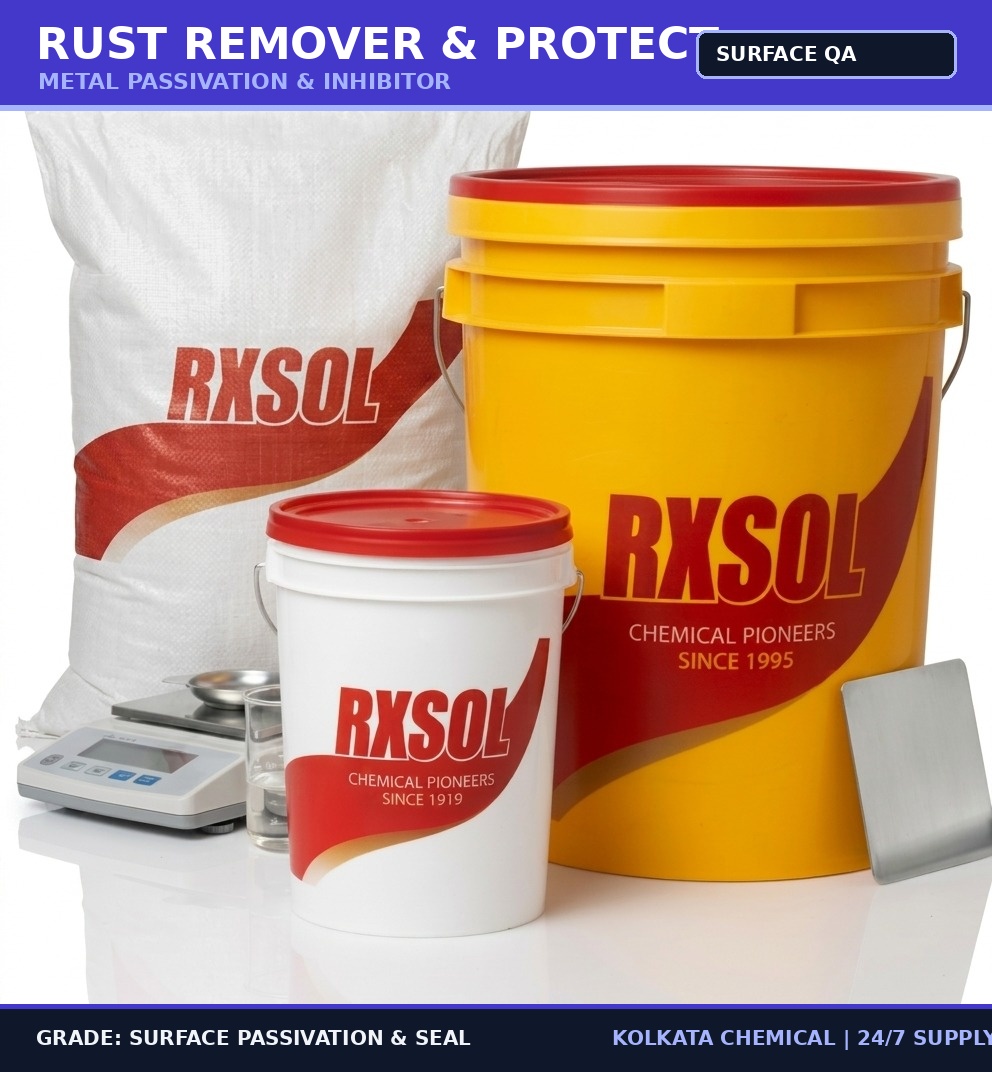
SUITABLE FOR vertical rust removal, For safe and easy removal of rust from iron and steel. RXSOL Jelly is useful for preparing metal surfaces for painting. Paint will adhere better to iron and steel surfaces when cleaned will RXSOL Jelly. It is also

Bio degradable NON Hazardous Rust Remover , SUITABLE FOR vertical rust removal,   Its Rust removal solution is safe and non flamable so even it can be ship by air .
Recommended to use a RXSOL ORG - 6 wash after rust removal , to protect FURTHER RUSTING.

For safe and easy removal of rust from iron and steel. RXSOL Jelly is useful for preparing metal surfaces for painting. Paint will adhere better to iron and steel surfaces when cleaned will RXSOL Jelly. It is also an ideal pretreatment for all galvanized surfaces prior to painting.

Application

Directions

For general cleaning of iron and steel, apply full strength with a paint brush, roller or sponge. Allow a dwell time of 5 to 20 minutes depending on the amount of rust to be removed. If heavy encrustations are present, use a wire brush to clean before applying. In severe conditions, it may be necessary to apply RXSOL Jelly several times. If this occurs, allow a longer dwell time, overnight if possible.

Dose

Technical specifications

Technical Information

Appearance: Clear Viscous Liquid   Solubility: 100%
Density: 8.67Lbs./Gal.   pH Level: 1
Odor: Mild   Rinsing: Complete
Flash Point: None   Stability: Stable
Foaming: Moderate    
Note

Material Safety

This product is for industrial and institutional use only. Corrosive, contains phosphoric acid.

Remarks / Precaution

Procedure to remove rust from metal using Rust Stain Remover SAFE JELLY

Step 1

Clean rusty surface by Hard / Metal brush, If Possible.

Step 2

Use protective gloves, long sleeves, pants and safety glasses before opening the can of Rust Stain Remover SAFE JELLY.

Step 3

Apply the viscous jelly to the rusty surface by paintbrush until the entire object is coated with the jelly. Then keep Rust Stain Remover SAFE JELLY to react with rust for 10 - 20 Minutes time.

Step 4

Again use hard brush / steel wool on rusted areas to remove the rust. The rust will easily come off as you scrub. If the rust does not come off easily, allow the Rust Stain Remover SAFE JELLY to sit for five additional minutes.

Step 5

Finally rinse or flush  the entire rusted area with tap water.

Step 6

Then to protect from further rusting neutralize the surface by use of RXSOL Alkaline Passivator  RXSOL-19-1521-050 onto the surface of the metal object until it is coated.

Step 7

Scrub the surface of the object with a scrub brush and rinse with water from a garden hose. The RXSOL-19-1521-050 neutralizes the acid and stops it from continuing to act on the metal. Allow the metal object to air dry.

MSDS

Porduct Name               Rust Stain Remover SAFE JELLY
Part Number   RXSOL-18-1012-025

Company Details:....

RX MARINE INTERNATIONAL
105, A wing , BSEL , TECH PARK.
VASHI ,NEW BOMBAY 400703 INDIA

Branch : Kandla, Mumbai , Chennai, Vizag, Kolkata, UAE , OMAN , CANADA and KENYA  

Phone +91 22 20871200 - 1400
Fax +91 22 27612100 :::AOH :0091 9821214367
Email mail@rxmarine.com
Website www.rxmraine.com

Hazardous Component(s)               Cas No                        Percentage            
Phosphoric acid          7664-38-2 10 - 30
2-Propanol 67-63-0 1 - 5
Xanthan gum 11138-66-2  1 - 5
Sulfuric acid 7664-93-9 0.1 - 1
Silica, amorphous, fumed, crystal-free 112945-52-5 0.1 - 1
Diiron trioxide 1309-37-1 0.1 - 1
Magnesium oxide 1309-48-4 0.1 - 1
Aluminium oxide 1344-28-1 0.1 - 1
Alcohols, C11-14-iso-, C13 rich, EO~ 78330-21-9  0.1 - 1
Proprietory Blend - Non Hazardous --- ---
 
                                                                        EMERGENCY OVERVIEW                                                                                                                                                          
DANGER:                   MAY BE CORROSIVE TO METALS.
                                   CAUSES SEVERE SKIN BURNS AND EYE DAMAGE.
                                   MAY CAUSE AN ALLERGIC SKIN REACTION.


                               HAZARD CLASS                                                                                                      HAZARD CATEGORY                                                                                                            
CORROSIVE TO METALS    1
SKIN CORROSION                                                                    1A
SERIOUS EYE DAMAGE                                                                      1
SKIN SENSITIZATION 1

Precautionary Statements

Prevention Keep only in original container. Do not breathe vapors, mist, or spray. Wash thoroughly after handling. Contaminated work clothing should not be allowed out of the workplace. Wear protective gloves, eye protection, and face protection.
Response
IF SWALLOWED: Rinse mouth. Do NOT induce vomiting. If on skin (or hair): Take off immediately all contaminated clothing. IF INHALED: Remove person to fresh air and keep comfortable for breathing.
IF IN EYES: Rinse cautiously with water for several minutes. Remove contact lenses, if present and easy to remove. Continue rinsing. Immediately call a poison control center or physician. If skin irritation or rash occurs: Get medical attention. Wash contaminated clothing before reuse. Absorb spillage to prevent material damage.
Storage Store locked up. Store in corrosive resistant container with a resistant inner liner
Disposal Dispose of contents and/or container according to Federal, State/Provincial and local governmental regulations.
 
2 % of the mixture consists of ingredient(s) of unknown acute toxicity.
 
Classification complies with OSHA Hazard Communication Standard (29 CFR 1910.1200) and is consistent with the provisions of the
United Nations Globally Harmonized System of Classification and Labeling of Chemicals (GHS).

Inhalation Move to fresh air. If not breathing, give artificial respiration. If breathing is difficult, give oxygen. Get medical attention
Skin contact Immediately flush skin with plenty of water (using soap, if available). Remove contaminated clothing and footwear. Wash clothing before reuse. Get medical attention
Eye contact Rinse immediately with plenty of water, also under the eyelids, for at least 15 minutes. Get medical attention.
Ingestion DO NOT induce vomiting unless directed to do so by medical personnel. Never give anything by mouth to an unconscious person. Get medical attention.
Symptoms See Section 11.

Extinguishing media                                        Foam, dry chemical or carbon dioxide
Special firefighting procedures Wear self-contained breathing apparatus and full protective clothing, such as turn-out gear. In case of fire, keep containers cool with water spray.
Unusual fire or explosion hazards Not flammable, however Hydrogen gas may be liberated if product contacts powdered metals or metals above 185°F.
Hazardous combustion products  Hydrogen.

Environmental precautions Do not allow product to enter sewer or waterways
Clean-up methods Remove all sources of ignition. Evacuate and ventilate spill area; dike spill to prevent entry into water system; wear full protective equipment during cleanup. Soak up with inert absorbent material (e.g. sand, silica gel, acid binder, universal binder, sawdust). Scrape up as much material as possible. Store in a partly filled, closed container until disposal. Flush with water. Neutralize acid using lime or a lime based agent compatible with the product. Refer to Section 8 "Exposure Controls / Personal Protection" prior to clean up.

Handling Use only with adequate ventilation. Prevent contact with eyes, skin and clothing. Do not breathe vapor and mist. Wash thoroughly after handling. Keep container closed. Refer to Section 8.
Storage  Keep from freezing. Keep container tightly closed and in a cool, well-ventilated place away from incompatible materials. 

Employers should complete an assessment of all workplaces to determine the need for, and selection of, proper exposure controls and protective equipment for each task performed.

Hazardous Component(s)             ACGIH TLV OSHA PEL                 AIHA WEEL                  OTHER                                             
Phosphoric acid
3 mg/m3 STEL
1 mg/m3 TWA
1 mg/m3 PEL None None
2-Propanol
200 ppm TWA
400 ppm STEL
400 ppm (980
mg/m3) PEL
None None
Xanthan gum None None None None
Sulfuric acid 
0.2 mg/m3 TWA
Thoracic fraction
1 mg/m3 PEL None None
Silica, amorphous, fumed, crystal-free
10 mg/m3 TWA
Inhalable dust.
3 mg/m3 TWA
Respirable fraction
20 MPPCF TWA
0.8 mg/m3 TWA
None None
Diiron trioxide
5 mg/m3 TWA
Respirable fraction.
10 mg/m3 PEL Fume. None None
Magnesium oxide
10 mg/m3 TWA
Inhalable fraction.
15 mg/m3 PEL Total
particulate.
None None
Aluminium oxide
1 mg/m3 TWA
Respirable fraction.
5 mg/m3 PEL
Respirable fraction.
15 mg/m3 PEL Total
dust.
None None
Alcohols, C11-14-iso-, C13 rich, EO~ None None None None


Engineering controls  Provide adequate local exhaust ventilation to maintain worker exposure below exposure limits.    
Respiratory protection Use a NIOSH approved air-purifying respirator if the potential to exceed established exposure limits exists.
Eye/face protection Safety goggles or safety glasses with side shields. Full face protection should be used if the potential for splashing or spraying of product exists. Safety showers and eye wash stations should be available.
Skin protection Use chemical resistant, impermeable clothing including gloves and either an apron or body suit to prevent skin contact.

Physical state Gel
Colour Characteristic
Odor Lime
Odor Threshold Not available
pH 1.5 - 2.5
Vapor pressure Not available
Boiling point/range 212 °F (100°C) None Approximately
Melting point/ range Not applicable
Specific gravity 1.191
Vapor density Not available
Flash point Not determinable
Flammable/Explosive limits - lower  Not applicable
Flammable/Explosive limits - upper Not applicable
Autoignition temperature Not applicable
Evaporation rate Not applicable                                                 
Solubility in water Soluble  
Partition coefficient (n-octanol/water)  Not applicable
VOC content 2.4 %; 28.6 g/l (calculated)
Viscosity Not available
Decomposition temperature Not available

Stability                    Stable under normal conditions of storage and use.
Hazardous reactions Will not occur.
Hazardous decomposition products Hydrogen, by reaction with metals
Incompatible materials Caustics. Powdered metals                                                                      
Reactivity
Not available.
Conditions to avoid Elevated temperatures. Heat, flames, sparks and other sources of ignition. Store away from incompatible materials.

Relevant routes of exposure Skin, Inhalation, Eyes, Ingestion          
Inhalation Causes respiratory tract irritation. Respiratory tract burns
Skin contact Causes skin irritation. Causes skin burns. May cause allergic skin reaction
Eye contact Causes serious eye damage. Causes eye irritation. May cause eye burns.
Ingestion Harmful if swallowed.


Hazardous Component(s)  LD50s and LC50s               Immediate and Delayed Health Effects                                       
Phosphoric acid
Oral LD50 (RAT) = 1,530 mg/kg
Dermal LD50 (RABBIT) = 2,740 mg/kg
Irritant, Corrosive
2-Propanol
Oral LD50 (RAT) = 5,045 mg/kg
Oral LD50 (RABBIT) = 6,410 mg/kg
Oral LD50 (RAT) = 4.7 g/kg
Oral LD50 (RABBIT) = 8.0 g/kg
Oral LD50 (RABBIT) = 5.03 g/kg
Dermal LD50 (RABBIT) = 12,800 mg/kg
Allergen, Blood, Brain, Central nervous
system, Irritant, Kidney, Liver, Spleen
Xanthan gum None Irritant
Sulfuric acid Inhalation LC50 (RAT, 1 h) = 347 mg/l Carcinogen, Corrosive, Irritant, Lung
Silica, amorphous, fumed, crystal-free None Nuisance dust
Diiron trioxide None
Allergen, Cardiac, Central nervous system,
Irritant, Kidney, Liver, Lung
Magnesium oxide None
Blood, Central nervous system, Immune
system, Irritant
Aluminium oxide None Irritant, Nuisance dust, Corrosive
Alcohols, C11-14-iso-, C13 rich, EO~ None Central nervous system, Irritant


Hazardous Component(s)      NTP Carcinogen          IARC Carcinogen       OSHA Carcinogen                                                          
(Specifically Regulated)                                                
Phosphoric acid          No No No
2-Propanol No No No
Xanthan gum No No No
Sulfuric acid
Known To Be Human
     Carcinogen
Group 1  No
Silica, amorphous, fumed, crystal-free No No No
Diiron trioxide No No No
Magnesium oxide No No No
Aluminium oxide No No No
Alcohols, C11-14-iso-, C13 rich, EO~ No No No

Ecological information   Not available   

Recommended method of disposal Follow all local, state, federal and provincial regulations for disposal.
Hazardous waste number Not a RCRA hazardous waste.

UN number ADR/RID:1805                                 IMDG:1805                                                  IATA: 1805
UN proper shipping name  ADR/RID:Phosphoric acid solution  IMDG:Phosphoric acid solution                   IATA:Phosphoric acid solution 
Transport hazard class(es)      ADR/RID: 8                                      IMDG: 8                                                       IATA: 8
Packaging group ADR/RID: III                                     IMDG: III                                                      IATA: III

TSCA 8 (b) Inventory Status All components are listed or are exempt from listing on the Toxic Substances Control Act Inventory
TSCA 12 (b) Export Notification None above reporting de minimis
CERCLA/SARA Section 302 EHS Sulfuric acid (CAS# 7664-93-9)
CERCLA/SARA Section 311/312 Immediate Health, Delayed Health
CERCLA/SARA Section 313 None above reporting de minimis
CERCLA Reportable quantity Phosphoric acid (CAS# 7664-38-2) 5,000 lbs. (2,270 kg)  2-Propanol (CAS# 67-63-0) 100 lbs. (45.4 kg)
California Proposition 65 This product contains a chemical known in the State of California to cause cancer.
CEPA DSL/NDSL Status All components are listed on or are exempt from listing on the Canadian Domestic Substances List.

Other Information

The information above is believed to be accurate and represents the  best information   currently    available  to us.  However,   we   make no warranty of merchantability or any other warranty, express or implied, with respect to such information, and  weassume  no liability resulting from its use. Users should make  their  own  investigations  to determine the suitability of the information for their particular purposes. In no event shall be liable for any claims, losses, or damages of any third party or for lost profits or any special, indirect, incidental, consequential or exemplary damages, howsoever arising, even if Rx Marine International  has been advised of the possibility of such damages.

DISCLAIMER OF LIABILITY :The information in this SDS was obtained from sources which we believe are reliable. However, the information is provided without any warranty, express or implied, regarding its correctness. The conditions or methods of handling, storage, use or disposal of the product are beyond our control and may be beyond our knowledge. For this and other reasons, we do not assume responsibility and expressly disclaim liability for loss, damage or expense arising out of or in any way connected with the handling, storage, use or disposal of the product. This MSDS was prepared and is to be used only for this product. If the product is used as a component in another product, this MSDS information may not be applicable.

Need a quote for this product?

Tell us the grade, packing and quantity you need — we ship across India and to major ports.

Request a quote office@kolkatachemical.com