Oxygen Remover Scavanger Plus is a catalysed liquid solution of Hydrazine and diethylhydroxylamine (DEHA). Its volatile properties ensure distribution throughout the boiler and condensate system, and hence protects against oxygen corrosion in all parts of the system. The product also provides the required conditions for the establishment of a passivating layer of magnetite on all inner surfaces. RXSOL-50-5022-025 is a low toxicity product, suitable for high, medium and low pressure boiler systems.
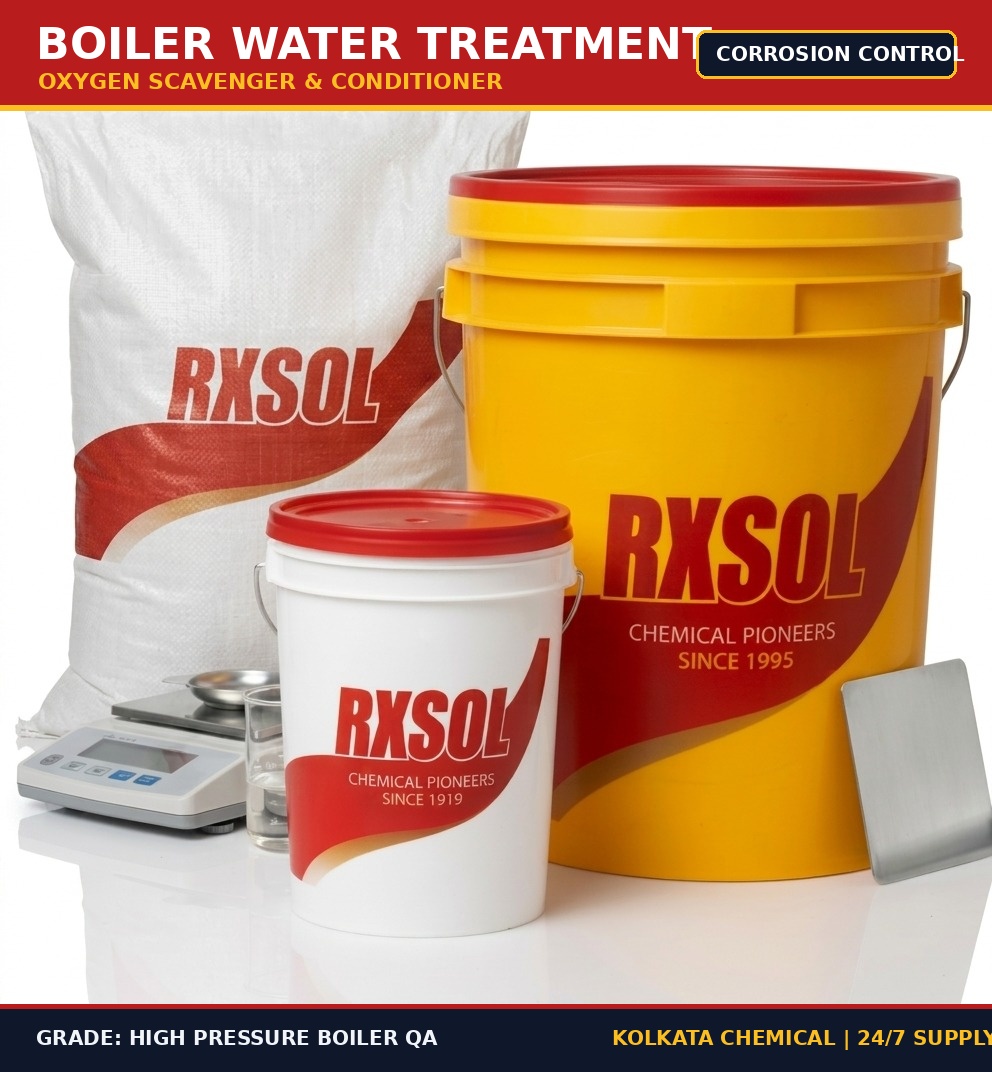
RXSOL-50-5022-025 The objective is to maintain a hydrazine residual between 0.05-0.2 ppm depending on operating pressure and boiler designe. Actual consumption is determined under operating conditions. A normal dosage is approximately 1 ltr. per day, depending of system layout.
Hydrazine is a convenient reductant because the by-products are typically nitrogen gas and water. Thus, it is used as an ANTIOXIDANT, an oxygen scavenger, and a corrosion inhibitor in water boilers and heating systems.
Hydrazine is mainly used as a foaming agent in preparing polymer foams
TESTING PROCEDURE ::: http://rxmarine.com/hydrazine-test-kit
Directions for use
This product is formulated for use in conjunction. Oxygen Scavenger Plus can be used in any boiler system, and in conjunction with mechanical deaeration systems. Removal of dissolved oxygen is vital for prevention of corrosion and especially pitting corrosion in boilers. When dosed into a boiler system, Oxygen Scavenger Plus will react with dissolved oxygen and form non corrosive compounds. The product is volatile, and left over product from oxygen scavenging in the pre-boiler section will evaporate and assist protection of the steam and condensate system. No solid materials are produced when using Oxygen Remover Scavanger Plus.
Dosing method
Rx Marine International recommends continuously into the boiler feed line and Boiler Water Treatment Dosing Unit.
Dosing should be controlled so that the DEHA residual in the condensate is between 0.08-0,30 ppm. The consumption will depend on feed water temperature and the amount of water fed into the boiler. For more information about initial dosage and dose rate please consult your nearest Customer Centre.
Test result condensate PPM DEHA
0.00 - 0.08 0.08 - 0.30 0.30 +
Increase dose 25% Maintain dose Decrease dose 25%
Sampling and testing
A representative sample of Condensate should be drawn for analysis daily. The sample should always be taken from the same sampling point, cooled and tested immediately By Rxsol Test Kit. It is important that regular testing is carried out, to ensure the correct level of treatment is maintained.
| Product Specifications: | |
|
Density |
1 |
|
Packing, Type |
PLASTIC |
|
Volume |
25 l |
|
pH |
10.5 |
|
Colour |
LIGHT YELLOW |
|
Appearance |
LIQUID |
Directions for use
This product is formulated for use in conjunction.Oxygen Scavenger Plus can be used in any boiler system, and in conjunction with mechanical deaeration systems. Removal of dissolved oxygen is vital for prevention of corrosion and especially pitting corrosion in boilers. When dosed into a boiler system, Oxygen Scavenger Plus will react with dissolved oxygen and form non corrosive compounds. The product is volatile, and left over product from oxygen scavenging in the pre-boiler section will evaporate and assist protection of the steam and condensate system. No solid materials are produced when using Oxygen Scavenger Plus.
Dosing method
Rx Marine International recommends continuously into the boiler feed line and Boiler Water Treatment Dosing Unit.
Dosing should be controlled so that the DEHA residual in the condensate is between 0.08-0,30 ppm. The consumption will depend on feed water temperature and the amount of water fed into the boiler. For more information about initial dosage and dose rate please consult your nearest Customer Centre.
Test result condensate PPM DEHA
0.00 - 0.08 0.08 - 0.30 0.30 +
Increase dose 25% Maintain dose Decrease dose 25%
Sampling and testing
A representative sample of Condensate should be drawn for analysis daily. The sample should always be taken from the same sampling point, cooled and tested immediately By Rxsol Test Kit. It is important that regular testing is carried out, to ensure the correct level of treatment is maintained.
Features
• Fast acting, liquid oxygen scavenger.
• Safe and easy to use, low toxicity.
• Reduces corrosion of iron and copper, increasing system life and reliability.
• Neutralises acids occurring in condensate system.
• Volatile product, provides distribution and protection throughout the boiler system, economical in use.
• Suitable for use in conjunction with combined and co-ordinated treatment programmes.
• Organic product, no dissolved solids added.
• Simple test to determine treatment level.
Features
• Fast acting, liquid oxygen scavenger.
• Safe and easy to use, low toxicity.
• Reduces corrosion of iron and copper, increasing system life and reliability.
• Neutralises acids occurring in condensate system.
• Volatile product, provides distribution and protection throughout the boiler system, economical in use.
• Suitable for use in conjunction with combined and co-ordinated treatment programmes.
• Organic product, no dissolved solids added.
• Simple test to determine treatment level.
The establishment of protective metal oxide lay-ers through the use of reducing agents (such as hydrazine, hydroquinone, and other oxygen scavengers) is known as metal passivation or metal conditioning. Although "metal passivation" refers to the direct reaction of the compound with the metal oxide and "metal conditioning" more broadly refers to the promotion of a protective surface, the two terms are frequently used interchangeably.
The reaction of hydrazine and hydroquinone, which leads to the passivation of iron-based metals, proceeds according to the following reactions:
| N2H4 | + | 6Fe2O3 | ® | 4Fe3O4 | + | 2H2O | + | N2 |
| hydrazine | hematite | magnetite | water | nitrogen |
| C6H4(OH)2 | + | 3Fe2O3 | ® | 2Fe3O4 | + | C6H4O2 | + | H2O |
| hydroquinone | hematite | magnetite | benzoquinone | water |
Similar reactions occur with copper-based metals:
| N2H4 | + | 4CuO | ® | 2Cu2O | + | 2H2O | + | N2 |
| hydrazine | cupric oxide | cuprous oxide | water | nitrogen |
| C6H6O2 | + | 2CuO | ® | Cu2O | + | C6H4O2 | + | H2O |
| hydroquinone | cupric oxide | cuprous oxide | benzoquinone | water |
Magnetite and cuprous oxide form protective films on the metal surface. Because these oxides are formed under reducing conditions, removal of the dissolved oxygen from boiler feedwater and condensate promotes their formation. The effective application of oxygen scavengers indirectly leads to passivated metal surfaces and less metal oxide transport to the boiler whether or not the scavenger reacts directly with the metal surface.
![]()
| Product Name | : | RXSOL-50-5022-025 |
| Product Type | : | Oxygen Remover Scavanger Plus |
Company Details:
RX MARINE INTERNATIONAL
105, A wing , BSEL , TECH PARK.
VASHI ,NEW BOMBAY 400703 INDIA
Stock Point : Mumbai, Kandla, Kolkata, Fujairah, Chennai, Visakhapatnam, Muscat Oman
| Phone | : | +91 22 27815541 / 42 |
| Fax | : | +91 22 2781 1318 :::AOH :0091 9821214367 |
| : | mail@rxmarine.com |

| Chemical Name | Concentration | CAS Number | EC Number | R Phrases* | Symbols |
| Hydroquinone | 1 | 123-31-9 | 204-617-8 | 22, 40, 41, 43, 50,68 | Xn, N |
| Diethyl hydroxylamine85% | 10-30 | 3710-84-7 | 223-055-4 | 10,20/21, 36/37/38 | Xn |
| Hydrazine | 10-15 | 302-01- 2 | |||
| Non classified ingredients |
60-90 |
*See Section 16

|
Odour |
Smells of ammonia |
|
Appearance |
Liquid, pale yellow, soluble in water |
|
Contact with eyes |
Causes irritation |
|
Contact with skin |
Causes irritation, Can be absorbed through skin, Harmful by inhalation and in contact with skin (R20/21) |
|
Inhalation |
Harmful by inhalation and in contact with skin (R20/21) |
|
Ingestion |
The ingestion of significant quantities may cause gastro-intestinal disturbances |

|
Contact with skin |
Remove contaminated clothing immediately and drench affected skin with plenty of water. Then wash with soap and water. Seek medical attention if irritation persists. Contaminated clothing should be laundered before reuse. |
|
Contact with eyes |
If substance has got into eyes, immediately wash out with plenty of water for at least 15 minutes. Obtain immediate medical attention. |
|
Ingestion |
Never make an unconscious person vomit or drink fluids. Do not induce vomiting. |
|
Inhalation |
Remove patient to fresh air. Keep warm and at rest. Seek medical attention if ill effects occur. |
|
General |
In case of accident or if you feel unwell, seek medical advice immediately (show the label where possible) (S45). |

- Non combustible
- Nitrogen and carbon oxides may be formed
- Not flammable. In case of fire use extinguishing media appropriate to surrounding conditions

|
Personal Precautions |
Wear protective clothing as per section 8. |
|
Environmental Precautions |
No special precautions are required for this product. |
|
Clean Up Actions |
Absorb spillage in inert material and shovel up Ventilate the area and wash spill site after material pick-up is complete |
|
Special Precautions |
Wear protective clothing as per section 8. |

|
Handling |
Wear protective clothing as per section 8. Avoid contact with skin and eyes (S24/25). Eyewash bottles should be available. |
|
Storage |
Keep only in the original container in a cool, well ventilated place (S3/9/49) |

|
Exposure Limits |
TLV (TWA) 0.5 mg/m3 (Hydroquinone) |
|
Exposure controls |
No special precautions are required for this product |
|
Occupational exposure controls |
Wear suitable protective clothing, including eye/face protection and gloves (plastic or rubber are recommended). Respiratory protection may be required under exceptional circumstances when excessive air contamination exists. Wear approved respirator if exposure likely to exceed MEL/OES. |

|
Odour |
Smells of ammonia |
|
Appearance |
Liquid, pale yellow, soluble in water |
|
pH |
10 - 11 at 100 % concentration, pH 8 - 9 at 1 % concentration |
|
Boiling point |
100 °C at 760 mm /Hg |
|
Vapour pressure |
not known |
|
Vapor density |
not known |
|
Freezing point |
0 °C at 760 mm/Hg |
|
Completely soluble in water |
|
|
Specific gravity (water=1) |
0.98 |
|
Non combustible |
|

- This article is considered stable under normal conditions
- Avoid overheating, Keep away from frost
- Incompatible with oxidizing substances
- See Section 5

|
Toxicological information |
LD50 (oral,rat) >2100 mg/kg.LD50 (skin,rabbit) 1300 mg/kg.LC50 (inhalation,rat) 3140 mg/l/4h.(Diethylhydroxylamine) |
|
Inhalation |
Vapours or aerosols may cause irritation of eyes, nose and respiratory tract |
|
Contact with skin |
Causes irritation |
|
Contact with eyes |
Causes irritation |
|
Ingestion |
May cause gastro-intestinal disturbances |
|
Carcinogenicity |
Hydroquinone: Category 3 Carcinogen Limited evidence of carcinogenic effect (R40) |
|
Mutagenicity |
Hydroquinone: Category 3 Mutagen |

|
Ecotoxicity |
May cause acute effects in the aquatic environment. This product contains components which are classified in the EU as dangerous for the environment |
|
Mobility |
Completely soluble in water |
|
Persistence and Biodegradability |
Degrades rapidly on exposure to air |
|
Bioaccumulation Potential |
Bioaccumulation of the components in this product is insignificant. |
|
Other Adverse Effects |
No environmental problems are expected when the product is used / handled correctly. In its intended use, the product will not be released into the environment. |

|
Classification |
EU Waste class: 07.01 |
|
Disposal considerations |
Do not discharge into drains or the environment, dispose to an authorised waste collection point.Disposal should be in accordance with local, state or national legislation |

- Not classified as hazardous for transport

|
Classification and labeling |
Contains Hydroquinone. May produce an allergic reaction. |
|
Risk Phrases |
Harmful by inhalation and in contact with skin (R20/21).Irritating to eyes, respiratory system and skin (R36/37/38) |
|
Safety Phrases |
In case of contact with eyes, rinse immediately with plenty of water and seek medical advice (S26).Wear suitable protective clothing, eye/face protection and gloves(S36/ 37/ 39).If swallowed seek medical advice immediately and show this container or label (S46).Avoid release to the environment. Refer to special instructions/Safety data sheets (S61) |

Text of R and S phrase codes used in this safety data sheet:- R10: Flammable; R20/21: Harmful by inhalation and
in contact with skin; R22: Harmful if swallowed; R36/37/38: Irritating to eyes, respiratory system and skin; R40:
Limited evidence of carcinogenic e ffect; R41: Risk of serious damage to eyes; R43: May cause sensitisation by
skin contact; R50: Very toxic to aquatic organisms; R68: Possible risk of irreversible effects.The information provided
about the product on this Safety Data Sheet has been compiled from knowledge of the individual constituents.The data given here is based on current knowledge and experience.This Safety Data Sheet describes the product in terms of safety requirements and does not signify any warranty with regard to the product's properties .The data given here only applies when product used for proper application(s) . The product is not sold as suitable for other applications - usage in such may cause risks not mentioned in this sheet. Do not use for other application n(s) without seeking advice from manufacturer This Safety Data Sheet is provided in compliance with The Dangerous Substances Directive (67/548/EEC) This Safety Data Sheet is provided in compliance with The Dangerous Preparations Directive (88/379/EEC) This Safety Data Sheet is provided in compliance with The Safety Data Sheets Directive (2001/58EC
DISCLAIMER OF LIABILITY :The information in this SDS was obtained from sources which we believe are reliable. However, the information is provided without any warranty, express or implied, regarding its correctness. The conditions or methods of handling, storage, use or disposal of the product are beyond our control and may be beyond our knowledge. For this and other reasons, we do not assume responsibility and expressly disclaim liability for loss, damage or expense arising out of or in any way connected with the handling, storage, use or disposal of the product. This MSDS was prepared and is to be used only for this product. If the product is used as a component in another product, this MSDS information may not be applicable.