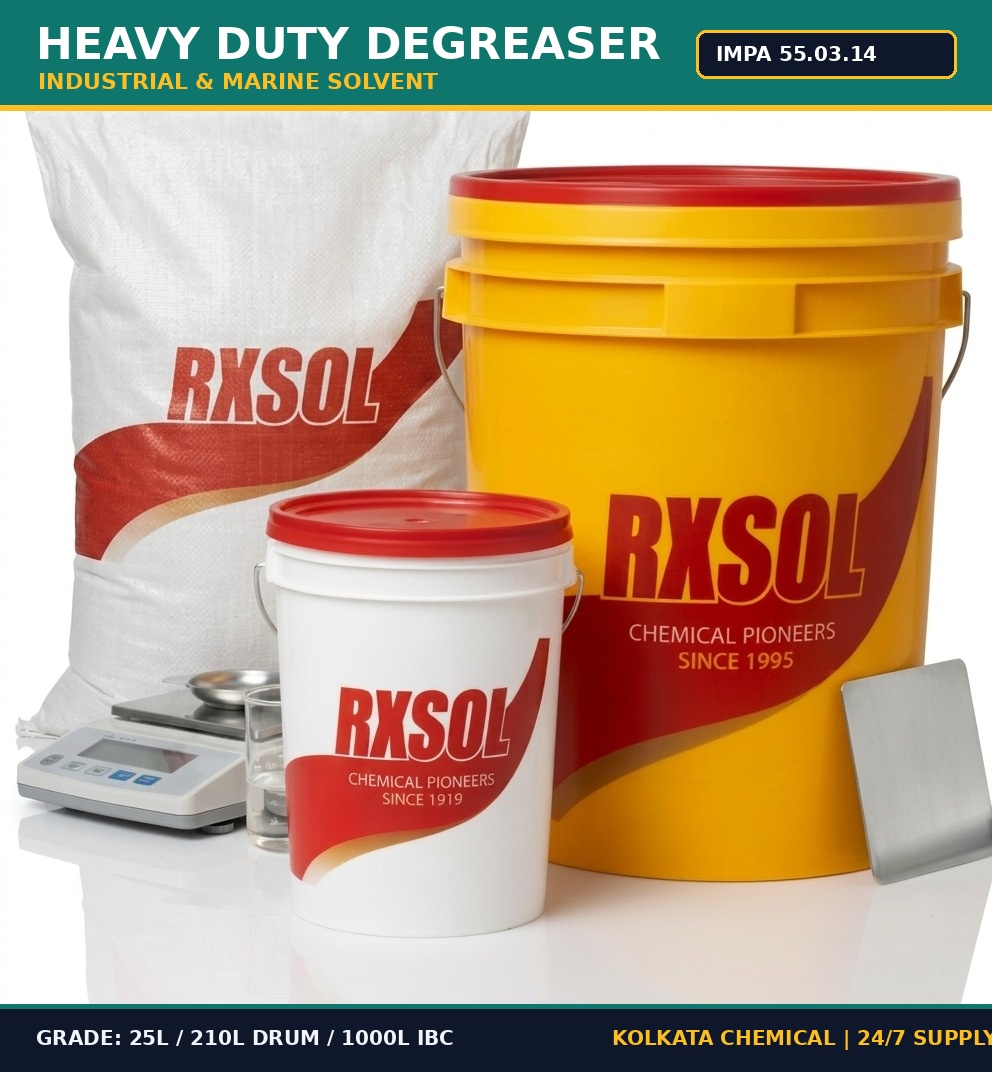
DEGREASER

DEGREASER for power plant & Heavy Industries
Category

Degreaser cleaner makes oil soluble in water. Degreaser higher concentration not only resulting oil cleaning effect smoothly but also its costing less in terms of area covered per unit wise.

Dose

Note

Degreaser manufacturer supplier and exporter

Remarks / Precaution

Degreaser Cleaner is specialized Oil greaser deposited cleaning product, Which is effectively cleans grease, oils, cutting fluids, greasy soils, prints, and other greasy contamination.

Packing sizes
250 Ml, 500 ml, 1, 5, 10, 20, 25, 50, 210 Ltr export quality container available at Navi Mumbai, Gandhidham, Visakhapatnam, Chennai, Kolkata, Fujairah, Dubai.
MSDS

Product Name

Degreaser

Part Number RXSOL-41-8649-025

Company Details:
RX MARINE INTERNATIONAL
105, A wing , BSEL , TECH PARK.
VASHI ,NEW BOMBAY 400703 INDIA

Branch : Kandla, Mumbai, Vizag, Chennai, Kolkata Fujairah UAE and Oman

Phone +91 22 27815540 / 41 / 42
Fax +91 22 2781 1318 :::AOH :0091 9821214367
Email 123@rxmarine.com
Website www.rxmarine.com

Name     of        Substance                          Cas Number EC Number Weight %
Natural Alcohol 64-17-5 200-578-6 70 - 60%
MEK 78-93-3 201-59-0 10-20
Surfactant

Proprietary

  20 -30%


Signal word Water Soluble
Hazard statement(s)

H319     Causes serious eye irritation.

Precautionary statements

P210: Keep away from heat / sparks / open flames / hot surfaces ‒ No smoking.

P233: Keep container tightly closed.

P240: Ground/bond container and receiving equipment.

P241: Use explosion-proof electrical / ventilating / lighting equipment.

P242: Use only non-sparking tools.

P243: Take precautionary measures against static discharge.

P280: Wear protective gloves / protective clothing /eye protection.

P264: Wash skin thoroughly after handling.

P303+ P361+P353: If on skin or hair remove/ take off immediately all contaminated clothing. Rinse skin with                                         water.

P305+P351+P338: IF IN EYES: Rinse cautiously with water for several minutes. Remove contact lenses, if                                          present and easy to do. Continue rinsing.

P337+P313: If eye irritation persists: Get medical advice/attention.

P370 + P378: In case of fire: Use powder, alcohol-resistant foam, lots of water, carbon dioxide for extinction.

P403 + P235: Store in a well-ventilated place. Keep cool.

P501:Disposal: Dispose of contents / container to a specialised waste disposal plant in accordance with local                / regional regulations

Main Hazard Harmful if swallowed or inhaled. Possible aspiration hazard if swallowed (can enter lungs and cause damage). May be irritating to the skin, eyes and respiratory tract. Over exposure may cause CNS depression. Possible reproductive hazard.
Health effects – eyes Moderately irritating. Exposure to liquid, vapours, fumes or mist may cause irritation. Direct contact may cause irritation, redness, pain, corneal inflammation and possible corneal damage.
Health effects – skin Repeated or prolonged contact may result in defatting, redness, pain, itching, inflammation, cracking and possible secondary infection. Repeated skin contact may result in allergic skin reaction in a very small proportion of individuals.
Health effects – ingestion

Large doses lead to  poisoning while repeated ingestion can lead to alcoholism. Alcohol abuse and dependence can have a profound effect on work performance and tendency to accidents at work.11-13 The presence of denaturants and surgfactant 

Health effects – inhalation Intoxicating if continuously inhaled for a long period of time. Occupational Exposure Limits (8-hour reference period) 1000ppm (1900mg/m3 ).30May cause respiratory tract irritation.
Carcinogenicity Long-term consumption of alcoholic beverages demonstrates an increase in the occurrence of breast cancer and colorectal cancer. Malignant tumours of the oral cavity, Pharynx, Larynx, Oesophagus and Liver is also causally related to the consumption of alcoholic beverages.31 Some studies20, 21 have shown an excess incidence of laryngeal cancer over the expected from exposure to synthetic alcohol, with Diethyl Sulphate probably being the causative agent
Mutagenicity Ethanol has been found to be non- mutagenic in the Salmonella microsome test, 22 but some transient mutagenic changes have been observed in male, but not female, mice treated with rather large doses.23-25 Ethanol is mutagenic in man via its first metabolite, Acetaldehyde. Acetaldehyde induces chromosomal aberrations, sister-chromatid exchanges and cross-links between DNA strands.32
Neurotoxicity Over exposure may cause Central Nervous System (CNS) depression

Product in eye Flush immediately with water or neutral saline solution for at least 15 minutes. Seek medical attention.
Product on skin Remove contaminated clothing and rinse contaminated area with soap and water. If skin irritation persists, seek medical attention.
Product ingested            If victim is conscious, give 1-3 glasses of water or milk to dilute stomach contents. If spontaneous vomiting occurs, or when vomiting is induced, monitor for breathing difficulty. Do not make an unconscious or semi – conscious person vomit. Keep affected person warm at rest. Get medical attention for substantial ingestions and/or gastrointestinal symptoms.
Product inhaled Remove the victim to fresh air. If not breathing, ensure open airway and institute cardiopulmonary resuscitation (CPR). If breathing is weak, irregular or has stopped apply artificial respiration. Oxygen may be beneficial. Keep affected person warm and at rest. Get immediate medical attention.

Extinguishing media Use dry chemical, alcohol foam or carbon dioxide to extinguish fire. Water may be ineffective but should be used to cool fire- exposed containers, structures and to protect personnel. If leak or spill has not ignited, ventilate area and use water spray to disperse gas or vapour and to protect personnel attempting to stop a leak. Use water to dilute spills and to flush them away from sources of ignition. Do not flush down public sewers or other drainage systems.
Special Hazards            

Vapours form flammable or explosive mixtures with air at room temperature. Vapour or gas may spread to distant ignition sources and flash back. Run – off to sewer may cause fire or explosion hazard. Containers may explode in heat of fire. Vapours may concentrate in confined areas. Irritating or toxic substances may be emitted upon thermal decomposition. Hazardous composition products such as carbon oxides may form.

Protective clothing Exposed fire fighters should wear approved self-contained breathing apparatus with full face mask and full protective equipment.

Personal precautions

Exposed fire fighters should wear approved self-contained breathing apparatus with full face mask and full protective equipment.

Enviromental  Precautions  Prevent liquid entering sewers. Do not allow to enter surface waters, storm drains, etc.
Small spills Take immediate steps to stop and contain the spill. Caution should be excised regarding personnel safety and exposure to be spilled material. Eliminate all sources of ignition and wear protective clothing. Absorb small spills onto paper towels and evaporate in a safe place e.g. in a fume hood. Flush the contaminated area with plenty of water.
Large spills Stop leak if you can do it without risk. Contact your local fire department. Eliminate all sources of ignition and static; restrict access to area until completion of clean-up procedure. Wear adequate protective equipment, use self-contained breathing apparatus in confined poorly-ventilated areas. Large quantities should be absorbed on to sand, vermiculite or an equivalent absorbent material and removed to a safe area for disposal. Flush the contaminated area with plenty of water. Incineration is the recommended method of disposal

Suitable material It is is not corrosive to metals and may be stored in stainless steel, mild steel or aluminiumcontainers. It may also be stored in HDPE containers.
Handling/ storage precautions Ground lines and equipment used during transfer to reduce the possibility of static spark-initiated fire or explosion. Store in approved flammable liquid storage containers. Keep containers tightly closed as this material readily absorbs moisture. Store away from incompatible materials. Store in a cool, dry well ventilated area away from sparks, flames and other sources of ignition. Eliminate all sources of static electricity. Use non sparking electrical and ventilation systems.

Engineering Control Engineering control methods to reduce hazardous exposures are preferred. General methods include mechanical ventilation dilution and local exhaust, process or personnel enclosure, control of process conditions and process modification e.g. substitution of a less hazardous material. Administrative controls and personal protective equipment may also be required. Use a non-sparking, grounded ventilation system separate from other exhaust ventilation systems. Exhaust directly to the outside. Supply sufficient replacement air to make up for air removed by exhaust system.
Personal   Protection Respiratory If exposure limits are exceeded or if irritation is experienced, an approved respirator for organic vapours is generally acceptable. For high concentrations and for oxygen-deficient atmospheres, use approved air- supplied respirator. Full respiratory protection should be readily available in case ofspillage.
Exposure Limits:
 
Country 8 Hour – TWA Hygiene Limit STEL
US (OSHA) 1900 mg/m³ (1000ppm) None
US (ACGIH) 1900 mg/m³ (1000ppm) None
Germany (MAK)* 960 mg/m3 (500ppm) Peak limit cat. II,1
UK (OES) 1920 mg/m³ (1000ppm) None
Slovak Republic 960 mg/m3 (500ppm) 1920 mg/m3 (1000ppm) (30 min, 4x per shift)
Czech Republic 1000 mg/m³ 3000 mg/m³
Personal protection – hand Rubber (Butyl) or neoprene gloves are recommended.
Personal protection – eye  Prevent eye contact with this material. Wear chemical tight safety goggles where eye exposure is reasonably probable. Provide an eyewash station immediately accessible to the work area. Contact lenses should not be worn when working with this chemical.
Personal protection – skin  Avoid skin contact. When working with this substance, wear appropriate chemical protective gloves. Wear protective suit/ overalls. Depending upon conditions of use, additional protection may be necessary such as face shield, apron, etc.
Other protection Provide a safety shower immediately accessible to the work area.

Appearance         Colourless,  liquid
Odour Characteristic pleasant odour
pH  Neutral
Boiling point 98⁰C - 80⁰C
Melting point - 130⁰C to - 112⁰C
Flash point 82⁰C
Auto-flammability 450⁰C
Explosive properties Vapours can form explosive mixtures with air. All sources of ignition or static must be.
excluded. Oxidizing properties None
Vapour pressure 59 mm Hg at 20⁰C
Density 0.80 kg/m3 – 0.809 kg/m3 at 25⁰C
Solubility – water Miscible with water in all proportions
Solubility – solvent Miscible with ether, methanol, chloroform and acetone
Solubility – coefficient 1100 @ 37⁰C33

Recativity                                             Stable at normal ambient temperature and pressure.
Chemical Stability No decomposition if stoned and applied as directed.
Incompatible materials See section 3 (chemical hazards).
Hazardous decomposition products

Incomplete combustion can generate carbon monoxide and carbon dioxide

Condition to Avoid Overheating, flames, sources of ignition or static electricity. Oxidizing agents. Vapour/ air mixtures are explosive. Keep away from heat and sources of ignition.

Acute toxicity

Short-term hazards

Acute oral toxicity Ethanol : LD50 rat: 7,060 mg/kg; literature value

Acute inhalation toxicity Ethanol : LC50 rat: 66,000 mg/l; literature value; 4 h

Acute dermal toxicity Ethanol : LDLo rabbit: 20,000 mg/kg; literature value

NOAEL - 2400 mg/kg (2%) - for rats

LOAEL – 3600 mg/kg (3%) - for rats 

Skin and eye contact                                   

Redness, pain (refer to Section 3 for further information)

Chronic toxicity Refer to Section 3.
Carcinogenicity Refer to Section 3
Mutagenicity Refer to Section 3
Neurotoxicity Refer to Section 3
Reproductive hazards Refer to Section 3

Aquatic toxicity – fish In high concentration it harms fish and plankton; LC50 (fish, 96 hours) – 15.3 mg/L (Pimephales promelas)
Aquatic toxicity – daphnia Threshold for deleterious effects in small crustaceans upwards of 7.800 mg/l; EC50 (Daphnia, 48 hours) – 5012 mg/L (Ceriodaphnia dubia)
Aquatic toxicity – algae Toxic threshold concentration: Pseudomonas putida upwards of 6.500mg/l, Scenedesmus quadricauda upwards of 5.000mg/l, Microsystis aeruginosa upwards of 1.450ml/L
Biodegradability                     

IC50 (algae, 72 hours) – 275 mg/L

This product is readily biodegradable. Ethanol is widely recognized as being readily biodegradable in the environment as it is both a metabolite of and nutrient for microbes. There are no persistent. 

Bio – accumulation This product in not expected to bio accumulate through the food chains in the environment. The very low log KOW of –0.31 is indicative of a low bioaccumulation potentia.
Mobility This product is likely to volatize rapidly into the air because of its high vapour pressure. The product is poorly absorbed onto soils or sediments. Adsorption coefficient (KOC) solid phase/liquid phase = 1 (highly mobile)
German wgk 1 (low hazard to water)


Disposal methods Only under conditions approved by local authorization. See also Section 6.
Disposal of packaging Empty containers may contain flammable and hazardous residues. Always obey hazard warnings.

ADR/RID class 3
ADR/RID item No 3(b)
ADR/RID hazard identity No 3
IMDG – shipping name

Non Corrosive, Degreaser

IMDG – class 3
IMDG – packaging group II
IMDG – marine pollutant Not a marine pollutant
IMDG – EMS No F-E, S-D
IMDG – MFAG table No 3074
IATA – shipping name

Non Corrosive, Degreaser

IATA – class 3
IATA – subsidiary risk(s)  -
ADNR – class Class 3, Packaging Group II
UK – description Not available
UK- emergency action class Not available
UK – classification Not available
Tremcard No 1170

EEC hazard classification 200 – 578 - 6
Risk phases R11
Safety phases S2, S7, S9, S16, S33
National legislation

Hazardous Substances Act 15 of 1973 and Regulations

Occupational Health and Safety Act 85 of 1993 (Hazardous Chemical Substances Regulations)

International Legislation 

IATA Dangerous Goods Regulation (DGR) 59th Edition 2018

IMDG Code, International Maritime Dangerous Goods Code, 2008 Edition, Volume 1 and 2 

Other Information  

The information above is believed to be accurate and represents the  best information   currently    available  to us.  However,   we   make no warranty of merchantability or any other warranty, express or implied, with respect to such information, and  we assume  no liability resulting from its use. Users should make  their  own  investigations  to determine the suitability of the information for their particular purposes. In no event shall be liable for any claims, losses, or damages of any third party or for lost profits or any special, indirect, incidental, consequential or exemplary damages, howsoever arising, even if RX Marine International  has been advised of the possibility of such damages.

DISCLAIMER OF LIABILITY :The information in this SDS was obtained from sources which we believe are reliable. However, the information is provided without any warranty, express or implied, regarding its correctness. The conditions or methods of handling, storage, use or disposal of the product are beyond our control and may be beyond our knowledge. For this and other reasons, we do not assume responsibility and expressly disclaim liability for loss, damage or expense arising out of or in any way connected with the handling, storage, use or disposal of the product. This MSDS was prepared and is to be used only for this product. If the product is used as a component in another product, this MSDS information may not be applicable.


Need a quote for this product?

Tell us the grade, packing and quantity you need — we ship across India and to major ports.

Request a quote office@kolkatachemical.com