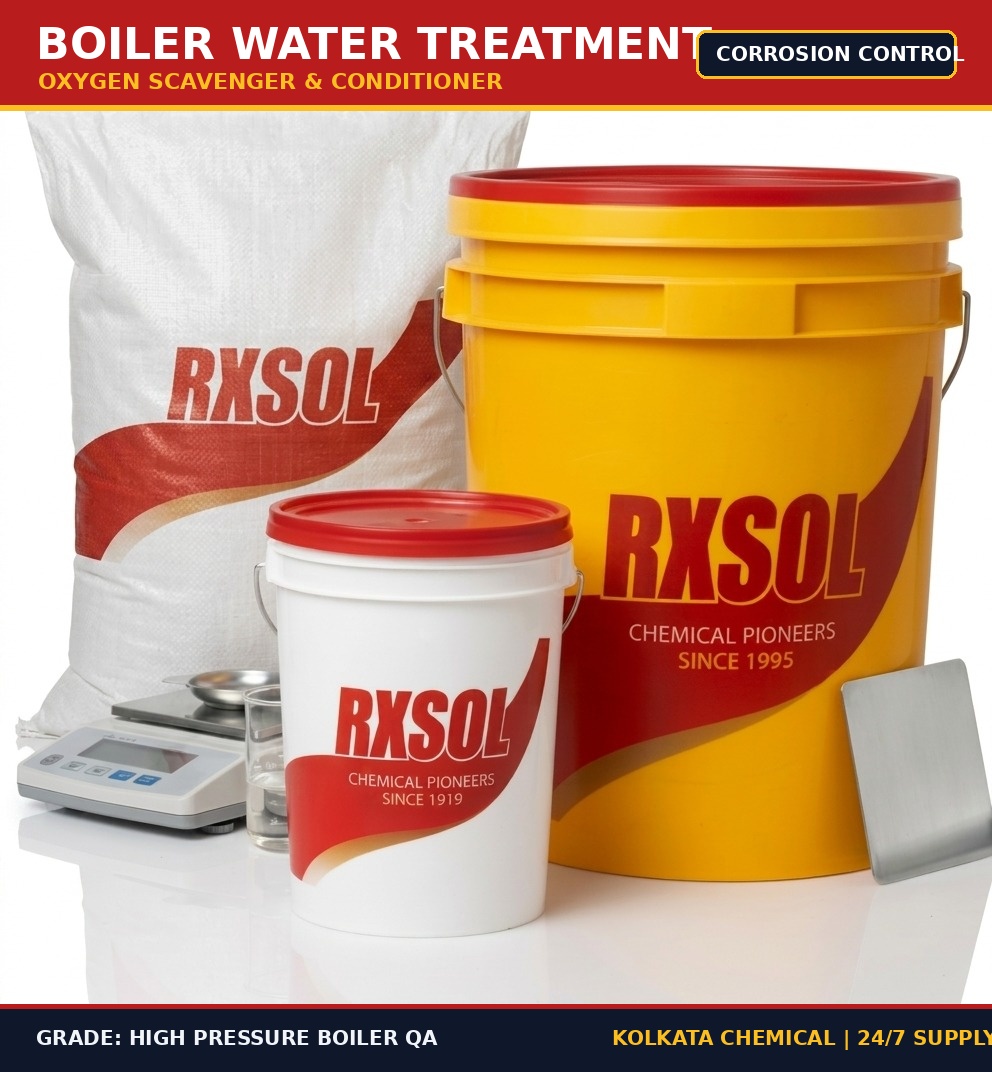
RXSOL-50-5005-025 Concentrated liquid neutralising agent for corrosion control in condensate and feed water systems, contain blends of low, medium and high volatility amines that provide great protection and neutralization of acidic gases, such as CO2 throughout a condensate system. Protects boiler surfaces by forming an iron tannate film.
A liquid neutralizing amine used to control corrosion and pH in steam and condensate systems.
RXSOL-50-5005-025 is a blend of volatile liquid / steam distributions ratios that neutralise the acid contaminants in condensate and feed water thus providing protection against acid corrosion in the complete system.The most common cause of acid corrosion in condensate and feed water systems is dissolved carbon dioxide. Condensate control neutralises this acid and maintains the condensate and feed water in an alkaline condition
Used in medium and high-pressure boilers including ultra high-pressure boilers.
Fields Of Application:-
RXSOL-50-5005-025 is an effective neutralizing type corrosion inhibitor & oxygen scavanger for steam condensation system. And can also be used to protect Boilers /Metals surfaces form corrosion.It removes oxygen efficiently in open feed systems and gives effective corrosion inhibition of boiler/exhaust gas economizer system surfaces . Its Chemical reaction by converting Fe2O3 (rust) to organic iron compound protect further IRON rust reaction .
Operating Process:-
RXSOL-CC72 neutralizes the acid components of feed water.The proportion of RXSOL-50-5005-025 depends upon the Carbon dioxide content of the condensate. Basically RXSOL-50-5005-025 neutralizes the acid contents & maintains the condensate and feed water in the alkaline condition. It also protects copper based metals.
RXSOL-50-5005-025 condensate is tested for PH to determine the dosage level. The PH limits are 8.3 - 9.0 . For an average system e. g. 10-M3, the dosage is approximately 0.65 ltr / day .
The necessary amount of RXSOL-50-5005-025 is required or injected as frequently as to maintain the pH of the condensate at the main condensate pump outlet between 8.6-9.5 . The amines pass over with the steam and have the dual function of elevating the pH of the steam/condensate and putting a protective micro film on the system pipe work. Acidic condensate is the result of carbonic acid (H2CO3) being formed as CO2 is released in the steam.Condensate prevents corrosion by carbonic acid on live systems. Its filming properties also reduce corrosion on shut down lines, when moisture and oxygen are present.
Not Compatible: Avoid copper, brass and aluminium.
Sampling and Testing
A representative condensate sample should be collected daily for analysis. The sample must always be taken from the same sampling point, cooled, and tested immediately. Testing should be carried out strictly in accordance with the test kit instructions, and all results must be recorded.
Condensate Control - Dosing Parameters (all pressure ranges)
The normal operating pH range is 8.5 to 9.2.
Measured pH
If the pH is below 8.5, increase the dosage by 25% and re-test after 24 hours, or sooner if required.
If the pH is within the range of 8.5 to 9.2, the system is under control and no dosage adjustment is required; continue routine monitoring.
If the pH is above 9.2, reduce the dosage by 25% and re-test after 24 hours, or sooner if required.
These values are recommended based on operational experience and are not intended to override boiler manufacturer guidelines or company operating procedures.
Regular testing is essential to ensure that treatment levels remain correct. Refer to the dosage chart to maintain the condensate pH within the target range of 8.5 to 9.2.
We carry a complete line of condensate treatment chemicals. Condensate treatment chemicals are used to increase the condensate pH, thus reducing corrosion to the entire boiler steam system. The most common product is a tri-blend amine of cyclohexylamine, morpholine, and diethylaminoethanol (DEAE) neutralizing amines, although we do have standard RXSOL products or we can custom blend to your needs.
RXSOL-50-5005-DCM1 10% DEAE, 10% Cyclo, 10% Morpholine
RXSOL-50-5005-DCM2 20% DEAE, 20% Cyclo, 20% Morpholine
RXSOL-50-5005-C 20% Cyclohexylamine
RXSOL-50-5005-D 20% DEAE
RXSOL-50-5005-M 20% Morpholine
RXSOL-50-5005-C5 50% Cyclohexylamine
RXSOL-50-5005-D 50% DEAE
RXSOL-50-5005-M5 50% Morpholine
- Easy to use liquid treatment.
- Neutralizes the acids occurring in the condensate system.
- Less maintenance required. Lower operating costs and increased reliability.
- Volatilizes and carries over with the steam and so is recycled. Dosage is economical and efficient.
- Simple test to determine level of treatment.
- Used for protection of condensate and feed water systems in boiler systems of all pressures.
RXSOL-50-5005-025 alkaline and the vapors are irritating to eyes and lungs. Avoid contact with eyes and skin. Do not take internally. Observe safety regulations wear Goggles, PVC gloves and Apron when handling Provide ample ventilation Avoid contact with skin in case of contacts wash with cupious amount of water immediately. If eyes are splashed give immediate and prolonged irrigation with clean running water and obtain medical attention.

| Product Name | : | RXSOL-50-5005-025 |
| Product Type | : | Condensnol Amine 25 Ltr |
Company Details:
RX MARINE INTERNATIONAL
105, A wing , BSEL , TECH PARK.
VASHI ,NEW BOMBAY 400703 INDIA
Stock Point : Mumbai, Kandla, Kolkata, Visakhapatanm - Gangavaram, Chennai - Ennore, Fujairah
| Phone | : | +91 22 27815540 / 41 / 42 |
| Fax | : | +91 22 2781 1318 :::AOH :0091 9821214367 |
| : | mail@rxmarine.com |

|
Chemical Name |
Concentration |
CAS Number |
EC Number |
R Phrases* |
Symbols |
|
2-Amino Ethanol |
5-10 |
141-43-5 |
205-483-3 |
20, 36/37/38 |
Xn |
|
2-Diethyl Amino Ethanol |
1-10 |
100-37-8 |
202-845-2 |
10, 20/21/22, 34 |
C |
| Dioctylamine C16H35N | 5-9 | 7681-52-9 | 1120-48-5 | ||
|
Propreitory Ingredients |
60-100 |
- |
- |
- |
- |

![]()
Corrosive
|
Odour |
Slight smell of ammonia. |
|
Appearance |
Liquid, pale yellow, soluble in water. |
|
Contact with eyes |
Vapours or aerosols may cause irritation of eyes, nose and respiratory tract |
|
Contact with skin |
May cause redness and irritation. |
|
Inhalation |
Vapours or aerosols may cause irritation of eyes, nose and respiratory tract. |
|
Ingestion |
Not regarded as a potential route of exposure., In cases of severe exposure,Gastro-intestinal disturbances may develop. |

|
Contact with skin |
Remove contaminated clothing immediately and drench affected skin with plenty of water. Then wash with soap and water.When in doubt or symptoms persist, seek medical attention Contaminated clothing should be laundered before reuse |
|
Contact with eyes |
If substance has got into eyes, immediately wash out with plenty of water for at least 15 minutes.Seek medical advice |
|
Ingestion |
Do not induce vomiting.Never give anything by mouth to an unconscious person.Give 200-300mls (half pint) water to drink.Seek immediate medical attention |
|
Inhalation |
Remove patient to fresh air.Seek medical attention if ill effects occur |
|
General |
In case of accident or if you feel unwell, seek medical advice immediately (show the label where possible) (S45) |

| Flammability | May be combustible at high temperature. |
| Suitable extinguishing media | Foam Carbon dioxide (CO2) Dry powder. |
| Unsuitable extinguishing media | For this substance/mixture no limitations of extinguishing agents are given. |
| Special hazards arising from the substance or mixture | Carbon oxides Nitrogen oxides (NOx) Combustible. Vapors are heavier than air and may spread along floors. Forms explosive mixtures with air on intense heating. Development of hazardous combustion gases or vapours possible in the event of fire. |
| Further information | Suppress (knock down) gases/vapors/mists with a water spray jet. Prevent fire extinguishing water from contaminating surface water or the ground water system |
|
Hazardous combustion products |
No data available |
| Advice for firefighters | Stay in danger area only with self-contained breathing apparatus. Prevent skin contact by keeping a safe distance or by wearing suitable protective clothing |
| Protective Equipment | No data available |
| Specific Hazards Arising from the Chemical | No data available |

| Personal precautions, protective equipment and emergency procedures | Advice for non-emergency personnel: Avoid generation and inhalation of dusts in all circumstances. Avoid substance contact. Ensure adequate ventilation. Evacuate the danger area, observe emergency procedures, consult an expert. For personal protection see section 8 |
| Personal Protection | Advice for non-emergency personnel: Avoid inhalation of dusts. Evacuate the danger area, observe emergency procedures, consult an expert. Advice for emergency responders: Protective equipment see section 8. |
| Enviromental Precaution | Do not let product enter drains. |
|
Methods and materials for containment and cleaning |
Cover drains. Collect, bind, and pump off spills. Observe possible material restrictions (see sections 7 and 10). Take up carefully. Dispose of properly. Clean up affected area. Avoid generation of dusts. |
| Reference to other sections | For disposal see section 13. |

| Advice on safe handling | For precautions see section 2.2. |
| Incompatible materials | Keep away from alkalis, strong oxidizing agents and metals. Provide containment walls of adequate capacity to hold any accidental spills. |
| Hygiene measures | Immediately change contaminated clothing. Apply preventive skin protection. Wash hands and face after working with substance. For precautions see section 2.2. |
| Advice on safe handling | No data available |
| Conditions for safe storage, including any incompatibilities | Storage conditions No metal containers. Tightly closed. Do not store near acids. Storage stabilityRecommended storage temperature |
| Storage conditions | Tightly closed. |
| Storage class | Storage class (TRGS 510): 8A: Combustible, corrosive hazardous materials |
| Specific end use(s) | Storage class (TRGS 510): 8A: Combustible, corrosive hazardous materials |
| Advice on general occupational hygiene |
No data available |

| Exposure controls | Ingredients with workplace control parameters. |
| Engineering Control | Personal protective equipmen |
| Eye/face protection | Use equipment for eye protection tested and approved under appropriate government standards such as NIOSH (US) or EN 166(EU). Tightly fitting safety goggles |
| Body Protection | Protective clothing |
| Skin protection | required |
| Respiratory protection |
Required when vapours/aerosols are generated. Our recommendations on filtering respiratory protection are based on the following standards: DIN EN 143, DIN 14387 and other accompanying standards relating to the used respiratory protection system. Recommended Filter type: Filter type ABEK The entrepeneur has to ensure that maintenance, cleaning and testing of respiratory protective devices are carried out according to the instructions of the producer. These measures have to be properly documented.
|
| Other Protection Measure | Handle in accordance with good industrial hygiene and safety practice. |
| Control of environmental exposure |
Do not let product enter drains. |
![]()
Goggles Gloves Suit Respirator

|
Odour |
Slight smell of ammonia |
|
Appearance |
Liquid, pale yellow, soluble in water |
|
PH |
11.5 - 12.5 at 100 % concentration, pH 10 at 1 % concentration |
|
Boiling point |
~ 100 °C at 760 mm /Hg |
|
Vapour pressure |
not known |
|
Vapour density |
not known |
|
Freezing point |
~ 0 °C at 760 mm/Hg |
|
Completely soluble in water |
|
|
Specific gravity (water=1) |
1.0 |
|
Not flammable |
|

| Reactivity | Forms explosive mixtures with air on intense heating. A range from approx. 15 Kelvin below the flash point is to be rated as critical |
| Chemical stability | The product is chemically stable under standard ambient conditions (room temperature) |
| Possibility of hazardous reactions | No data available |
| Conditions to avoid | Strong heating. |
| Incompatible materials |
Strong acids
|
| Hazardous decomposition products |
In the event of fire: see section 5 |

|
Toxicological information |
LD50 (oral,rat) 2100 mg/kg.( 2-Aminoethanol).LD50 (oral,rat) 1320 mg/kg.( 2-Diethylaminoethanol) |
|
Inhalation |
In cases of severe exposure, irritation may develop |
|
Contact with skin |
Causes irritation |
|
Contact with eyes |
Causes redness and irritation |
|
Ingestion |
The ingestion of significant quantities may cause gastro-intestinal disturbances |
|
Carcinogenicity |
No evidence of carcinogenic effects |

| Persistence and degradability | Biodegradability |
| Toxicity to fish | Toxicity to fish LC50 - Danio rerio (zebra fish) - 0,54 mg/l - 96,0 h |
| Toxicity to daphnia and other aquatic invertebrates | No data available |
| Toxicity | No data available |
| Toxicity to bacteria | No data available |
| Toxicity to algae | No data available) |
| Products Biodegradation | No data available |
| Mobility in soil | No data available |
| Results of PBT and vPvB assessment | This substance/mixture contains no components considered to be either persistent, bioaccumulative and toxic (PBT), or very persistent and very bioaccumulative (vPvB) at levels of 0.1% or higher. |
| Endocrine disrupting properties | The substance/mixture does not contain components considered to have endocrine disrupting properties according to REACH Article 57(f) or Commission Delegated regulation (EU) 2017/2100 or Commission Regulation (EU) 2018/605 at levels of 0.1% or higher. |
| Other adverse effects |
No data available |
|
Ecotoxicity |
This product does not contain ingredients which are classified in the EU as dangerous for the environment. |
|
Mobility |
Completely soluble in water |
|
Persistence and Biodegradability |
The components in this product are readily biodegradable. |
|
Bioaccumulation Potential |
Bioaccumulation of the components in this product is insignificant. |
|
Other Adverse Effects |
No environmental problems are expected when the product is used / handled correctly . In its intended use, the product will not be released into the environment.Presents little or no hazard to the aquatic environment. |

|
Classification |
EU Waste class: 07.01 |
|
Disposal considerations |
Do not discharge into drains or the environment, dispose to an authorised waste collection point. Disposal should be in accordance with local, state or national legislation |

- Not classified as hazardous for transport

|
Risk Phrases |
Irritating to eyes, respiratory system and skin (R36/37/38) |
|
Safety Phrases |
In case of contact with eyes, rinse immediately with plenty of water and seek medical advice (S26).Wear suitable gloves and eye/face protection (S37/39) |

Text of R and S phrase codes used In this safety data sheet :- R10: Flammable; R20 : Harmful by inhalation;
R20/21/22: Harmfulby inhalation, in contact with skin and if swallowed;
R34: Causes burns;
R36/37/38: Irritating to eyes, respiratory system and skin.The information provided about the product on t his Safety Data Sheet has been
compiled from knowledge of the individual constituents. Thedata given here is based on current knowledge and experience .
This Safety Data Sheet describes the productIn terms of safety requirements and does not signify any warranty with regard
to the product's properties The data given here only applies when product used for proper application(s).The product is not sold as suitable
For othe r applications - usage in such may cause risks not mentioned in this sheet.
Do not use for other application(s) without seeking advice from manufacturer.
This Safety Data Sheet is provided in compliance with The Dangerous Substances Directive (67/548/EEC)
This Safety Data Sheet is provided in compliance with The Dangerous Preparations Directive (88/379/EEC)
This Safety Data Sheet is provided in compliance with The Safety Data Sheets Directive (2001/58EC)
DISCLAIMER OF LIABILITY :The information in this SDS was obtained from sources which we believe are reliable. However, the information is provided without any warranty, express or implied, regarding its correctness. The conditions or methods of handling, storage, use or disposal of the product are beyond our control and may be beyond our knowledge. For this and other reasons, we do not assume responsibility and expressly disclaim liability for loss, damage or expense arising out of or in any way connected with the handling, storage, use or disposal of the product. This MSDS was prepared and is to be used only for this product. If the product is used as a component in another product, this MSDS information may not be applicable.
| Flammability | May be combustible at high temperature. |
| Suitable extinguishing media | Foam Carbon dioxide (CO2) Dry powder. |
| Unsuitable extinguishing media | For this substance/mixture no limitations of extinguishing agents are given. |
| Special hazards arising from the substance or mixture | Carbon oxides Nitrogen oxides (NOx) Combustible. Vapors are heavier than air and may spread along floors. Forms explosive mixtures with air on intense heating. Development of hazardous combustion gases or vapours possible in the event of fire. |
| Further information | Suppress (knock down) gases/vapors/mists with a water spray jet. Prevent fire extinguishing water from contaminating surface water or the ground water system |
|
Hazardous combustion products |
No data available |
| Advice for firefighters | Stay in danger area only with self-contained breathing apparatus. Prevent skin contact by keeping a safe distance or by wearing suitable protective clothing |
| Protective Equipment | No data available |
| Specific Hazards Arising from the Chemical | No data available |