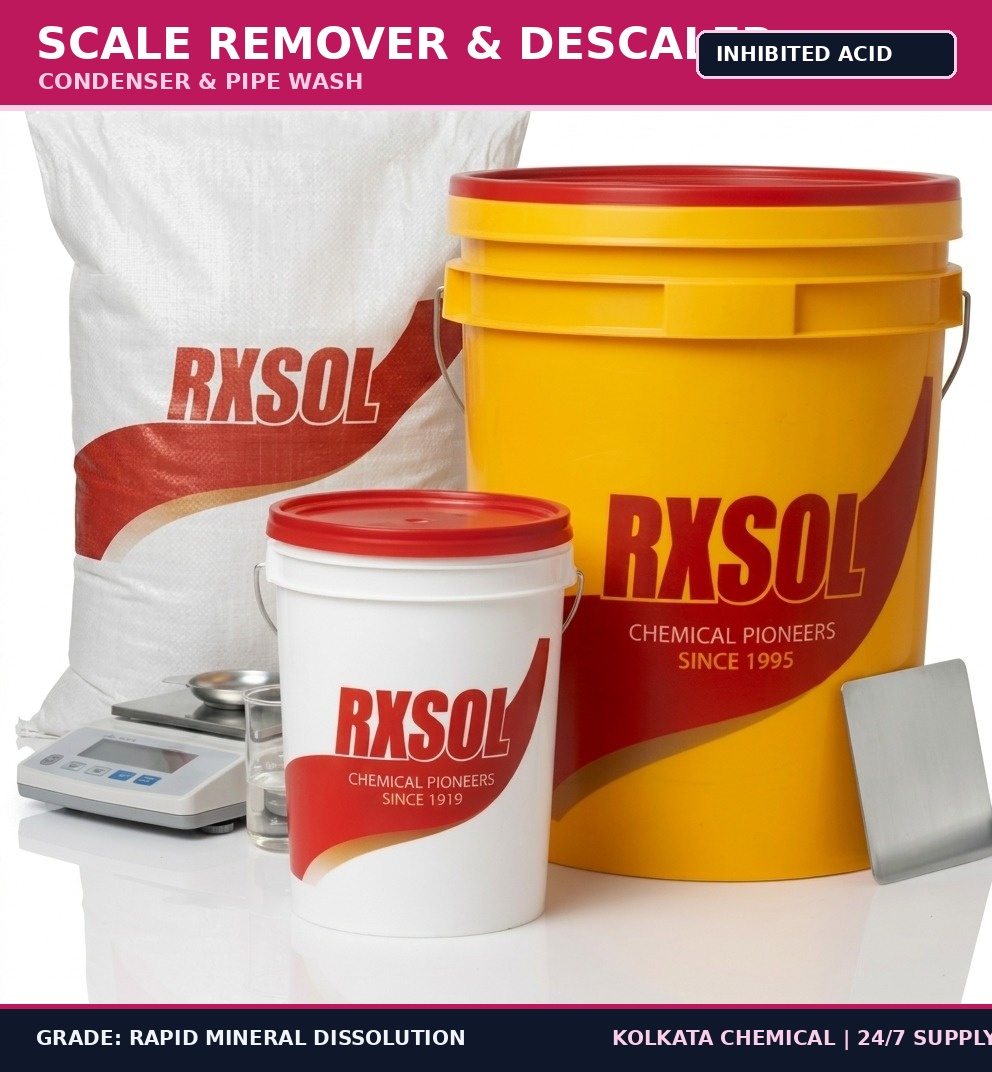
Citric Acid concentrate in liquid form is available in various packing. RXSOL brand CITRIC ACID liquid is blend of various organinc and inorganinc acid in calculated proportion to perform better cleaning action. Due to its equilibrium formulation, Its descaling and derusting properties increases.
Consistent and cost-effective supply of Liquid Citric Acid. Liquid Citric Acid, 50% is used as a sequestrant, dispersing agent, acidifier and flavoring agent also used as pH-control agent in the food and beverage industry. CITRIC ACID liquid solution is one of popular cleaner to dissolve lime scale, rust stain etc.
Liquid Citric Acid, 50% . We manufactures pure liquid of CITRIC ACID. Citric acid precipitate iron by both chelating. This is the reason why citric acid liquid used for iron control additive in the oil industry.
Citric Acid is a water treatment chemical used as pH control and for the removal of iron and other elements from fouled water softeners. Removes hard water built up, scale and lime. Citric Acid 50% Solution is used as a preservative, acidifier, chelator, and flavoring in various sections of the food and beverage industry.
PRODUCT SAFETY INFORMATION Keep containers tightly closed when not in use. Avoid contact with skin, eyes, and clothing. Avoid breathing vapors or mists. Remove contaminated clothing and wash thoroughly after handling. Hand protection: Use of gloves impermeable to the specific material handled, if necessary Eye protection: Chemical goggles or safety glasses. Face shield, if necessary Respiratory protection: Wear a NIOSH approved or equivalent dust respirator, if necessary DOT CODE GHS CODE Acute Toxicity, Dermal Category 5 Skin Irritation Category 3 Eye Irritation Category 2A HMIS CODE N/A
PHYSICAL PROPERTIES INFORMATION Physical state: Liquid Color: Clear colorless liquid Odor: Odorless pH: 2.2 (0.1 N sol) Specific Gravity: 1.24 – 1.26 STORAGE INFORMATION Keep container(s) tightly closed. Store this material in cool, dry, well ventilated areas. Protect container(s) against physical damage. Containers of this material may be hazardous when empty since they retain product residues (vapors, liquid). Shelf life: Stored under controlled conditions 1 year.
DELIVERY Containers: 55 Gal Plastic drums / 250 Gal Tote bin / Bulk tank trucks. NOTE Refer to the SDS for further health, safety and environmental information regarding this product. Information and recommendations in this technical data sheet are based on information believed to be reliable. However, the use of the product is beyond our control, and no guarantee expressed or implied is made as to the effects of such the results to be obtained id not used in accordance with directions or established safe practice. The buyer must assume all responsibility including injury or damage, resulting from misuse of the product as such, or combination with other materials. Issue date: March 1, 2016

| Product Name | Citric Acid Liq |
| Part Number | RXSOL-33-1102-100 |
Company Details:
RX MARINE INTERNATIONAL
105, A wing , BSEL , TECH PARK.
VASHI ,NEW BOMBAY 400703 INDIA
Branch : Kandla, Mumbai , Chennai, Vizag, Kolkata, UAE , OMAN , CANADA and KENYA
| Phone | +91 22 20871200 - 1400 |
| Fax | +91 22 27612100 :::AOH :0091 9821214367 |
| mail@rxmarine.com | |
| Website | www.rxmraine.com |

| Substances | Not relevant (mixture) |
Mixtures
Description of the mixture
| Name of substance | CAS No | Wt% |
Classification acc. to
GHS
|
| Citric acid | 77-92-9 | 25 – 50 |
Eye Irrit. 2 / H319
STOT SE 3 / H335
|
For the full text of the H-Statements mentioned in this Section, see Section 16.

Label elements
| Signal Word | Warning |
| Hazard Statements |
H319 Causes serious eye irritation
H335 May cause respiratory irritation
|
| Precautionary Statements |
Precautionary statements - prevention
P261 Avoid breathing dust/fume/gas/mist/vapours/spray
P280 Wear eye protection/face protection
Precautionary statements - response
P304+P340 IF INHALED: Remove victim to fresh air and keep at rest in a position comfortable for breathing
P305+P351+P338 IF IN EYES: Rinse cautiously with water for several minutes. Remove contact
lenses, if present and easy to do. Continue rinsing
P312 Call a POISON CENTER or doctor/physician if you feel unwell
Precautionary statements - storage
P403+P233 Store in a well-ventilated place. Keep container tightly closed
|
| Supplemental Hazard Statements | None |
| Other hazards |
Results of PBT and vPvB assessment
This mixture does not contain any substances that are assessed to be a PBT or a vPvB.
|

| General notes | Take off contaminated clothing. |
| Following inhalation | Provide fresh air. In all cases of doubt, or when symptoms persist, seek medical advice. |
| Following skin contact | Rinse skin with water/shower. In all cases of doubt, or when symptoms persist, seek medical advice. |
| Following eye contact | Rinse skin with water/shower. In all cases of doubt, or when symptoms persist, seek medical advice. |
| Following ingestion | Rinse mouth. Call a doctor if you feel unwell. |
| Most important symptoms and effects, both acute and delayed | Irritation, Cough, Dyspnoea |
| Indication of any immediate medical attention and special treatment needed | None |

| Suitable extinguishing media |
Co-ordinate firefighting measures to the fire surroundings
water spray, alcohol resistant foam, dry extinguishing powder, BC-powder, carbon dioxide (CO₂)
|
| Unsuitable extinguishing media | Water jet |
| Special hazards arising from the substance or mixture | Ingredients of the mixture combustible. The product itself does not burn. |
| Hazardous combustion products | Carbon monoxide (CO), Carbon dioxide (CO₂) |
| Advice for firefighters | In case of fire and/or explosion do not breathe fumes. Fight fire with normal precautions from a reasonable distance. Wear self-contained breathing apparatus. |

Personal precautions, protective equipment and emergency procedures
| For non-emergency personnel |
Avoid contact with skin, eyes and clothes. Do not breathe vapour/spray.
|
| Environmental precautions | Keep away from drains, surface and ground water. The product is an acid. Before discharge into sewage plants the product normally needs to be neutralised. |
| Methods and material for containment and cleaning up | |
| Advice on how to contain a spill | Absorb with liquid-binding material (sand, diatomaceous earth, acid- or universal binding agents). |
| Other information relating to spills and releases | Place in appropriate containers for disposal. |
| Reference to other sections | Hazardous combustion products: see section 5. Personal protective equipment: see section 8. Incompatible materials: see section 10. Disposal considerations: see section 13. |

| Precautions for safe handling | Provision of sufficient ventilation. |
| Advice on general occupational hygiene | Wash hands before breaks and after work. Keep away from food, drink and animal feedingstuffs. |
| Conditions for safe storage, including any incompatibilities |
Keep container tightly closed.
|
| Incompatible substances or mixtures | Observe hints for combined storage |
| Consideration of other advice: | |
| Specific designs for storage rooms or vessels | Recommended storage temperature: 15 – 25 °C |
| Specific end use(s) | No information available. |

| Name of substance | CAS No | End point | Threshol d level | Organism | Environmental compartment | Exposure time |
| Citric acid | 77-92-9 | PNEC | 0.44 mg/ | aquatic organisms | freshwater | short-term (single instance) |
| Citric acid |
77-92-9
|
PNEC | 0.44 mg/ | aquatic organisms | marine water | short-term (single instance) |
| Citric acid | 77-92-9 | PNEC | 1,000 mg/l | aquatic organisms | sewage treatment plant (STP) | short-term (single instance) |
| Citric acid | 77-92-9 | PNEC | 34.6 mg/kg | aquatic organisms | freshwater sediment | short-term (single instance) |
| Citric acid | 77-92-9 | PNEC | 3.46 mg/kg | aquatic organisms | marine sediment | short-term (single instance) |
| Citric acid | 77-92-9 | PNEC | 33.1 mg/kg | terrestrial organisms | soil | short-term (single instance) |
| Eye/face protection | Use safety goggle with side protection. |
| Skin protection |
Hand protection
Wear suitable gloves. Chemical protection gloves are suitable, which are tested according to EN 374.
For special purposes, it is recommended to check the resistance to chemicals of the protective gloves mentioned above together with the supplier of these gloves. The times are approximate values from
measurements at 22 ° C and permanent contact. Increased temperatures due to heated substances, body heat etc. and a reduction of the effective layer thickness by stretching can lead to a considerable reduction of the breakthrough time. If in doubt, contact manufacturer. At an approx. 1.5 times larger / smaller layer thickness, the respective breakthrough time is doubled / halved. The data apply only to the pure substance. When transferred to substance mixtures, they may only be considered as a guide.
Type of material
NBR (Nitrile rubber)
Material thickness
0,11 mm
Breakthrough times of the glove material
480 minutes (permeation: level 6)
Other protection measures
Take recovery periods for skin regeneration. Preventive skin protection (barrier creams/ointments) is recommended.
|
| Respiratory protection |
Respiratory protection necessary at: Aerosol or mist formation. Type: ABEK (combined filters against gases and vapours, colour code: Brown/Grey/Yellow/Green).
|
| Environmental exposure controls | Keep away from drains, surface and ground water. |

| Physical state | Liquid |
| Color | Colorless |
| Odor | Odorless |
| Melting point/freezing point | Not determined |
| Boiling point or initial boiling point and boiling range | ~100 °C at 1,013 hPa |
| Flammability | Non-combustible |
| Lower and upper explosion limit | Not determined |
| Flash point | Not determined |
| Autoignition temperature | Not determined |
| Decomposition temperature | Not relevent |
| pH (value) | 1 – 2 (20 °C) |
| Kinematic viscosity | Not determined |
| Water solubility | Miscible in any proportion |
| Partition coefficient n-octanol/water (log value) | This information is not available |
| Vapour pressure | 23 hPa at 20 °C |
| Density | 1.24 g /cm³ at 20 °C |
| Relative vapor density | Information on this property is not available |
| Particle characteristics | Not relevant (liquid) |
| Oxidising properties | None |
| Other information | |
| Information with regard to physical hazard classes |
Hazard classes acc. to GHS
(physical hazards): not relevant
|
| Other safety characteristics | |
| Miscibility | Completely miscible with water |

| Reactivity | This material is not reactive under normal ambient conditions. |
| Chemical stability | The material is stable under normal ambient and anticipated storage and handling conditions of temperature and pressure. |
| Possibility of hazardous reactions | Violent reaction with: strong oxidiser, Reducing agents, Metals, Bases |
| Conditions to avoid | There are no specific conditions known which have to be avoided. |
| Incompatible materials | Different metals |
| Hazardous decomposition products | Hazardous combustion products: see section 5. |

| Information on toxicological effects |
Test data are not available for the complete mixture.
|
| Classification procedure | The method for classification of the mixture is based on ingredients of the mixture (additivity formula). |
| Acute toxicity | Shall not be classified as acutely toxic. |
| Skin corrosion/irritation | Shall not be classified as corrosive/irritant to skin |
| Serious eye damage/eye irritation | Causes serious eye irritation. |
| Respiratory or skin sensitisation | Shall not be classified as a respiratory or skin sensitiser. |
| Germ cell mutagenicity | Shall not be classified as germ cell mutagenic |
| Carcinogenicity | Shall not be classified as carcinogenic. |
| Reproductive toxicity | Shall not be classified as a reproductive toxicant |
| Specific target organ toxicity - single exposure | May cause respiratory irritation. |
| Specific target organ toxicity - repeated exposure | Shall not be classified as a specific target organ toxicant (repeated exposure). |
| Aspiration hazard | Shall not be classified as presenting an aspiration hazard. |
| If swallowed |
Data are not available.
|
| If in eyes | Causes serious eye irritation |
| If inhaled | Irritation to respiratory tract, cough, Dyspnoea |
| If on skin | irritant effects, pruritis, localised redness |
| Other information | None |
| Endocrine disrupting properties | None of the ingredients are listed. |

| Toxicity | Shall not be classified as hazardous to the aquatic environment. |
| Biodegradation | Data are not available. |
| Bioaccumulative potential | Data are not available. |
| Mobility in soil | Data are not available. |
| Results of PBT and vPvB assessment | Data are not available. |
| Endocrine disrupting properties | Data are not available. |
| Other adverse effects | Data are not available. |

| Waste Treatment Methods | This material and its container must be disposed of as hazardous waste. Dispose of contents/container in accordance with local/regional/national/international regulations. |
| Sewage disposal-relevant information | Do not empty into drains. |
| Remarks | Waste shall be separated into the categories that can be handled separately by the local or national waste management facilities. Please consider the relevant national or regional provisions. |

| UN number | Not subject to transport regulations |
| UN proper shipping name | Not assigned |
| Transport hazard class(es) | Not assigned |
| Packaging group | Not assigned |
| Environmental hazards | Non-environmentally hazardous acc. to the dangerous goods regulations |
| Special precautions for user | There is no additional information. |
| Transport in bulk according to IMO instruments | The cargo is not intended to be carried in bulk. |
| Information for each of the UN Model Regulations | |
| Transport informationNational regulationsAdditional information(UN RTDG) | Not subject to transport regulations. UN RTDG |
| International Maritime Dangerous Goods Code (IMDG) - Additional information | Not subject to IMDG. |
| International Civil Aviation Organization (ICAO-IATA/DGR) - Additional information | Not subject to ICAO-IATA. |

| Safety, health and environmental regulations/legislation specific for the substance or mixture | There is no additional information. |
| Australian Inventory of Chemical Substances(AICS) | All ingredients are listed or exempt from listing. |
| Other information | Directive 94/33/EC on the protection of young people at work. Observe employment restrictions under the Maternity Protection Directive (92/85/EEC) for expectant or nursing mothers. |
| Chemical Safety Assessment | Chemical safety assessments for substances in this mixture were not carried out. |

| Other Information |
The information above is believed to be accurate and represents the best information currently available to us. However, we make no warranty of merchantability or any other warranty, express or implied, with respect to such information, and weassume no liability resulting from its use. Users should make their own investigations to determine the suitability of the information for their particular purposes. In no event shall be liable for any claims, losses, or damages of any third party or for lost profits or any special, indirect, incidental, consequential or exemplary damages, howsoever arising, even if Rx Marine International has been advised of the possibility of such damages. DISCLAIMER OF LIABILITY :The information in this SDS was obtained from sources which we believe are reliable. However, the information is provided without any warranty, express or implied, regarding its correctness. The conditions or methods of handling, storage, use or disposal of the product are beyond our control and may be beyond our knowledge. For this and other reasons, we do not assume responsibility and expressly disclaim liability for loss, damage or expense arising out of or in any way connected with the handling, storage, use or disposal of the product. This MSDS was prepared and is to be used only for this product. If the product is used as a component in another product, this MSDS information may not be applicable. |